

Originally published: June 2026 | Updated: July 2026
A certified Illinois appraiser protects all parties in an heir dispute by producing an independent, USPAP-compliant fair market value determination that no single heir controls and that Illinois courts accept as evidence under 755 ILCS 5/ Article XIV, Section 14-3.
When heirs disagree over what inherited property is worth — or whether to sell it — a licensed appraiser converts a subjective argument into a documented, court-defensible number every party can reference.
Heirs’ disputes over property value can delay estate closing by months and consume estate funds in attorney fees. Order an independent estate appraisal from Whitsitt & Associates before the dispute reaches the courthouse.
Heirs’ disputes over real estate value in Illinois probate stem from one fundamental problem: heirs have different financial interests in the outcome, and without a documented neutral valuation, every heir’s number reflects what they want rather than what the market supports.
A certified appraisal removes that dynamic by establishing fair market value through a methodology not directed by a single heir.
Heirs dispute property values most often in these situations: a sell-versus-keep disagreement, where one heir wants to liquidate the property for cash while another wants to retain or buy out the others’ shares — the heir who wants to sell quotes a high number, the heir who wants to buy out siblings quotes a low one.
Without an independent appraisal, neither number carries evidentiary weight. The second situation is an unequal distribution — when a will directs that one heir receives the family home while others receive liquid assets, every party scrutinizes the real estate value because the property’s appraised figure determines whether the distribution is actually equal.
The third situation is co-ownership after the estate closes: when multiple heirs inherit real estate as tenants in common, disagreements over maintenance, rental income, and the eventual sale price generate recurring valuation disputes that often escalate into partition actions under 755 ILCS 75/.
Heirs who present informal valuations — Zillow estimates, CMA printouts, or a neighbor’s opinion — do not resolve disputes. Every party can produce a different informal number, and courts that treat these as equivalent sources produce inconsistent outcomes.
A USPAP-compliant appraisal from a licensed Illinois appraiser serves as a neutral anchor because the appraisal methodology is documented, the comparable sales are identified, and the appraiser is legally required to be disinterested under 755 ILCS 5/Section 14-2.
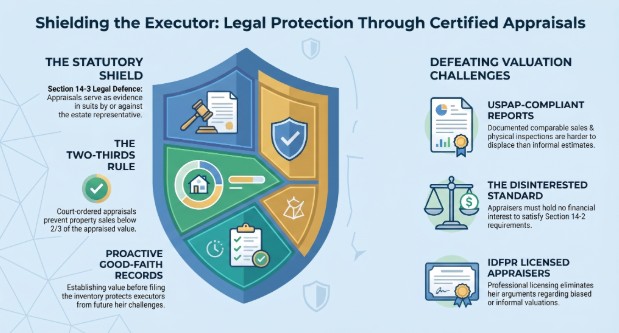
The executor faces personal liability exposure when heir disputes over property value escalate — and a certified appraisal is the executor’s primary legal protection against that exposure. Under 755 ILCS 5/ Article XIV, Section 14-3, inventories and appraisals may be introduced as evidence in any suit by or against the representative.
An appraisal is not conclusive if other evidence shows the estate was worth more or less, but a USPAP-compliant report with documented comparable sales, a physical inspection, and a clear methodology is far harder to displace than a competing informal estimate.
An executor who orders a licensed appraisal before filing the inventory establishes a documented record of good-faith valuation that protects against heir challenges under this section.
When the estate must sell real estate — because heirs cannot agree or because debts require liquidation — a second statutory protection applies.
Under 755 ILCS 5/ Article XX, Section 20-8, the court may appoint one, two, or three disinterested appraisers who inspect the premises, produce a written appraisal, and report to the court. When a court-ordered appraisal governs the sale, the property may not be sold for less than two-thirds of the appraised value.
An executor who proactively obtains a licensed appraisal before disputes reach this stage provides the court with a credible starting point and prevents heirs from arguing that the sale price was suppressed.
Any heir who believes the executor used a biased or informal valuation can challenge the inventory under Section 14-3, arguing the appraiser failed the disinterested standard required by 755 ILCS 5/ Section 14-2.
Whitsitt & Associates’ appraisers hold no financial interest in any estate outcome and hold active licenses issued by the Illinois Department of Financial and Professional Regulation (IDFPR) — satisfying the statutory disinterested standard and eliminating that avenue of challenge.
Executors facing heir pushback on property values should review the estate appraisal mistakes Illinois executors make before the inventory is filed, so the valuation record is complete from the first filing.
Heir disputes that escalate to attorney intervention cost the estate far more than the appraisal. Schedule your estate appraisal with Whitsitt & Associates and establish a protected valuation record before heirs escalate.
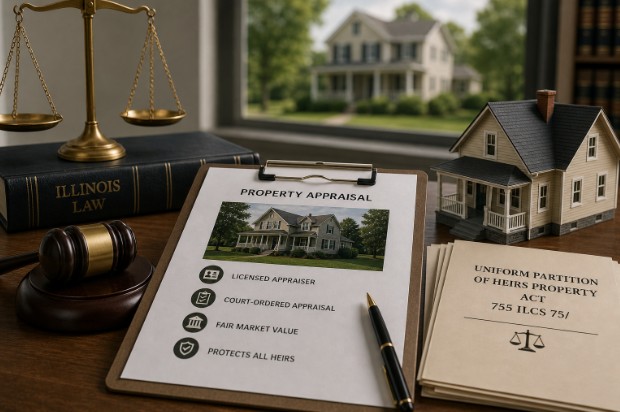
The Illinois Uniform Partition of Heirs Property Act — 755 ILCS 75/ — governs situations where heirs co-own inherited real estate as tenants-in-common and cannot agree on what to do with the property.
When the court determines the property qualifies as heir’s property, the Act requires the court to order an appraisal by a disinterested real estate appraiser licensed in Illinois before partition proceeds.
Under 755 ILCS 75/ Section 6, the licensed appraiser files a sworn or verified appraisal with the court on completion. Within 10 days of filing, the court orders notice to each party stating the appraised fair market value and that the appraisal is available at the clerk’s office.
Any party may file an objection within 30 days of that notice, and the court then conducts a hearing to determine fair market value no sooner than 30 days after notice is sent.
The court may consider additional valuation evidence from any party alongside the licensed appraisal — meaning a USPAP-compliant report with documented comparable sales is far harder to displace than an objecting heir’s informal estimate.
Once the court establishes fair market value, each co-owning heir who did not request partition by sale has 45 days to elect to buy out the interests of the heirs who did. The court-established appraised value governs the buyout price.
A certified appraisal that produces a well-documented, defensible fair market value directly protects the heir who wants to retain the property, because a competing inflated valuation cannot displace a USPAP-compliant report with documented comparable sales. Understanding the estate appraisal process in Champaign County helps heirs and their attorneys assess what a compliant report requires before the court-ordered process begins.
A beneficiary heir who disagrees with the executor’s property valuation may commission an independent licensed appraisal and introduce the report as evidence under 755 ILCS 5/ Section 14-3.
A licensed appraisal commissioned by a beneficiary heir — by a disinterested IDFPR-licensed appraiser applying USPAP methodology — carries the same evidentiary weight as the executor’s appraisal.
Two competing licensed appraisals provide the court with a documented foundation for a fair market value determination, rather than a credibility contest between a beneficiary’s online estimate and the executor’s licensed report.
Illinois probate law requires the appraiser to be disinterested under Section 14-2 — but the executor who selects the appraiser is not required to be disinterested in the outcome.
An executor who is also a beneficiary has an inherent financial interest in the valuation result. Heirs who believe the executor selected an appraiser whose value favors the executor’s share may petition the Champaign County probate court under 755 ILCS 5/ Article XXVIII, Section 28-5 for a hearing on any matter germane to estate administration — including appraiser selection and methodology.
A beneficiary heir who accepts real estate at an understated value in the estate inventory carries a lower stepped-up tax basis upon taking ownership under IRC Section 1014. When the heir eventually sells the property, the difference between the understated basis and the actual sale price becomes taxable as capital gain.
An independent, licensed appraisal that documents the accurate fair market value protects the heir’s long-term tax position, not just the immediate distribution outcome. Reviewing the relationship between estate appraisals and market analysis helps heirs understand this downstream tax risk before accepting a distribution based on an unchallenged executor valuation.
The most effective intervention point for a property valuation dispute is before the estate inventory is filed — not after heirs have retained attorneys and the conflict has entered the court record.
An executor who orders a USPAP-compliant appraisal from a disinterested licensed appraiser before filing the inventory gives every heir access to a shared, documented valuation baseline from the first filing.
Heir disputes that escalate into litigation frequently begin with inventories lacking this foundation. Reviewing the executor estate appraisal checklist for Illinois before the inventory filing date helps identify all assets requiring licensed appraisals, ensuring that no value is entered into the inventory without documentation.
An executor who shares the full appraisal report — not just the value conclusion — with all heirs and beneficiaries gives each party access to comparable sales, the adjustment grid, and the appraiser’s credentials for evaluation.
Heirs who can read the methodology and identify the comparable sales are positioned to accept the value or commission a rebuttal appraisal through legitimate channels. Heirs who receive only a value conclusion have no way to evaluate whether the conclusion is supported, and are more likely to assume it is not.
Understanding how to communicate effectively with your appraiser helps executors frame the appraisal report for non-specialist beneficiaries before sharing it with heirs.
When one heir wants to retain the family home and others want cash, the licensed appraised value becomes the buyout reference point for all parties. A buyout below the appraised value may require court approval.
A buyout at or above the appraised value satisfies the court’s fair distribution standard and removes the need for a partition action.
Executors and heirs who establish the appraised value early — before buyout negotiations begin — avoid the common escalation pattern in which each side argues from a self-serving number until both sides retain attorneys.
Reviewing the estate settlement appraisal process helps parties understand what a complete, court-ready report contains before ordering.
A properly documented appraisal is the lowest-cost dispute resolution tool available to Illinois heirs and executors. Contact Whitsitt & Associates before the dispute escalates, and let a licensed Central Illinois appraiser establish a neutral valuation that every party can work from.
Can an appraiser help resolve heir disputes over estate property in Illinois?
Yes. A licensed Illinois appraiser produces an independent, USPAP-compliant fair market value determination that no single heir controls. Under 755 ILCS 5/ Section 14-3, that appraisal may be entered as evidence in any suit involving the estate. A documented neutral valuation gives all parties a shared baseline and reduces the likelihood of litigation.
What is the Illinois Uniform Partition of Heirs Property Act, and how does it use appraisals?
The Illinois Uniform Partition of Heirs Property Act — 755 ILCS 75/ — governs co-owned inherited real estate when heirs cannot agree on partition or sale. When the court determines the property qualifies as heir’s property, 755 ILCS 75/ Section 6 requires the court to order a disinterested licensed Illinois appraiser to establish fair market value before partition or buyout proceeds.
Can a beneficiary heir commission their own appraisal to challenge the executor’s valuation?
Yes. Under 755 ILCS 5/ Section 14-3, any interested party may introduce evidence of value in a suit involving the estate representative. A licensed appraisal commissioned by a beneficiary carries the same evidentiary weight as the executor’s appraisal, provided the appraiser is disinterested and the report is USPAP-compliant.
What makes an appraisal defensible against heir challenges in Illinois probate?
A defensible appraisal includes a physical property inspection, comparable sales tied to the date of death, documented adjustments, the appraiser’s active IDFPR license number, and a full, USPAP-compliant report. A well-documented report is far harder to displace under Section 14-3 than a summary valuation or informal estimate.
Does Illinois law require a court-ordered appraisal in heir property partition cases?
Yes. Under 755 ILCS 75/ Section 6, when a partition action involves heir’s property, and co-tenants cannot agree on value, the court must order an appraisal by a disinterested licensed Illinois appraiser. The appraiser files a sworn valuation with the court, and parties have 30 days to object after receiving notice of the appraised value.
Can an executor be challenged for using a biased appraiser in the estate inventory?
Yes. An executor who uses an appraiser who fails to meet the disinterested standard under 755 ILCS 5/Section 14-2 exposes the inventory to challenge under Section 14-3. Any interested party may petition the Champaign County probate court under 755 ILCS 5/Article XXVIII, Section 28-5 for a hearing regarding appraiser selection and valuation methodology.
How does an estate appraisal affect the heir’s capital gains tax when they sell the property?
The estate appraisal establishes the stepped-up tax basis the heir carries into ownership under IRC Section 1014. An understated appraisal results in a lower basis, thereby increasing the taxable capital gain when the heir sells. An accurate, documented appraisal protects the heir’s long-term tax position regardless of the outcome of the distribution dispute.
What happens if two heirs present competing appraisals in an Illinois probate court?
The Champaign County probate court evaluates competing appraisals under the evidentiary standard of 755 ILCS 5/ Section 14-3. Both reports may be introduced as evidence, and the court considers methodology, comparable sale selection, appraiser credentials, and report completeness in weighing them against each other.
Is the cost of a dispute-related appraisal paid by the estate or by the heir personally?
An appraisal ordered by the executor as part of estate administration is a legitimate estate expense under 755 ILCS 5/ Section 14-2. An appraisal commissioned independently by a beneficiary heir to challenge the inventory is generally paid by that heir personally, unless the court orders otherwise as part of the proceedings.
When is the best time to order an estate appraisal to prevent heir disputes?
The best time is before the executor files the estate inventory — ideally within the first two weeks of receiving letters of office. An appraisal completed before the inventory filing provides every heir with a documented valuation baseline from the first court filing, preventing the escalation pattern in which heirs dispute a number before submission.