

Originally published: August 2024 | Updated: August 2026
Homeowners who pressure an appraiser toward a target value — through comparisons to a neighbor’s sale, a Zillow estimate, or a second appraisal already scheduled — risk the exact outcome federal law was written to prevent. A value opinion shaped by something other than the appraiser’s independent judgment.
The Appraiser Independence Requirements under Regulation Z prohibit coercion, bribery, or intimidation aimed at influencing a valuation, and appraisers are trained to document and report attempts to do so.
A homeowner gets the most accurate result from a professional appraisal by providing factual documentation and letting the appraiser work independently.
Homeowners preparing for an appraisal get the most accurate results with a residential appraisal from Whitsitt & Associates, along with clear, documented information for the appraiser.
Six common homeowner statements can read as pressure on an appraiser’s value opinion, even when offered with good intentions: claiming the home is worth more, citing a higher-priced comparable sale, mentioning unpermitted DIY work, quoting a Zillow estimate, referencing a neighbor’s appraisal, or disclosing a second appraisal already scheduled.
Each of these statements shifts the conversation away from verifiable facts and toward an outcome the homeowner wants, which is precisely the dynamic appraiser independence rules exist to prevent.
An appraiser who hears one of these comments may document it and, in some cases, is required to report attempted influence to the state licensing authority.
| Statement | Why It Backfires | Better Approach |
| “I believe the house is worth more.” | Signals an expected outcome rather than factual input | Let the appraiser reach an independent conclusion |
| “A similar home sold for much higher.” | Appraisers weigh location, condition, and features the comparison omits | Provide documentation of upgrades if asked |
| “I did a lot of work myself.” | Unpermitted DIY work can raise, not resolve, condition concerns | Share permits and receipts from licensed contractors |
| “Zillow says my house is worth…” | An automated estimate carries no in-person inspection | Share verified property records instead |
| “The neighbor’s appraisal came in higher.” | Each property differs in condition, upgrades, and timing | Focus on this property’s own documented features |
| “I’ve already scheduled a second appraisal.” | Can read as distrust of the appraiser’s process | Schedule any second opinion privately, after the first is complete |
Federal law prohibits coercion, bribery, extortion, or intimidation directed at a person preparing a property valuation, specifically to keep the value opinion based on the appraiser’s independent judgment rather than outside pressure.
The Appraiser Independence Requirements, codified at 12 CFR 1026.42 under Regulation Z, implement Section 129E of the Truth in Lending Act (15 U.S.C. 1639e), added by the Dodd-Frank Act in 2010 and effective since April 1, 2011.
The Appraiser Independence Requirements were written to apply to lenders, loan officers, and real estate agents involved in a mortgage transaction, not to a homeowner speaking informally during an inspection — but they establish why appraisers are trained to treat comments that signal a target value as a red flag rather than helpful input.
The rule replaced the earlier Home Valuation Code of Conduct and requires that parties to a transaction report suspected appraiser misconduct to the appraiser’s state licensing authority, so a homeowner can understand why appraisers are trained to treat pressure-signaling comments as a concern rather than helpful input.
DIY renovations without permits or contractor documentation can raise condition concerns rather than add the value a homeowner expects, and an automated online estimate carries no in-person inspection of the property’s actual condition.
An appraiser looks for permits and receipts from licensed contractors when evaluating a renovation; without them, unpermitted work may raise questions about code compliance rather than translate directly into added value.
A home condition checklist helps homeowners organize this documentation before the appraiser’s visit.
An automated valuation model, like the kind that powers a Zillow estimate, generates a value from public records and recent sales data without a physical inspection, which is why DIY and automated valuations can diverge from a licensed appraiser’s in-person conclusion.
A homeowner prepares most effectively by gathering documentation of recent renovations, upgrades, and maintenance records before the appraiser arrives, rather than relying on verbal claims during the visit.
A folder containing permits, contractor receipts, and a list of notable unique features provides the appraiser with verified information to consider.
Cleaning and addressing minor issues — a leaky faucet, a squeaky door — removes distractions that could otherwise draw attention during the inspection.
Homeowners working with complex or commercial properties benefit from organizing this documentation even more thoroughly, since these assignments often involve more variables for the appraiser to verify.
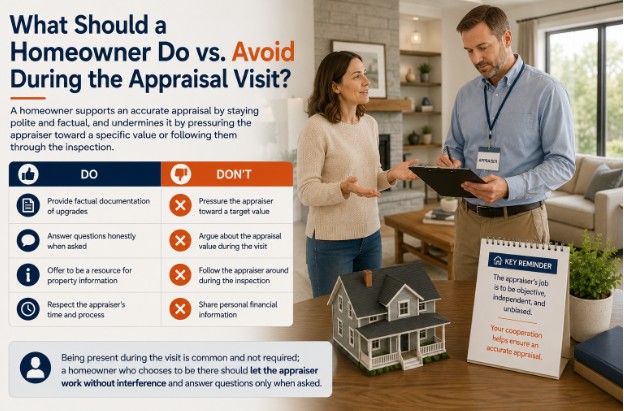
A homeowner supports an accurate appraisal by staying polite and factual, and undermines it by pressuring the appraiser toward a specific value or following them through the inspection.
| Do | Don’t |
| Provide factual documentation of upgrades | Pressure the appraiser toward a target value |
| Answer questions honestly when asked | Argue about the appraisal value during the visit |
| Offer to be a resource for property information | Follow the appraiser around during the inspection |
| Respect the appraiser’s time and process | Share personal financial information |
Being present during the visit is common and not required; a homeowner who chooses to be there should let the appraiser work without interference and answer questions only when asked.
A homeowner who disagrees with a completed appraisal should wait for the written report, review it for factual errors or missing information, and raise those specific points through the proper channels rather than during the inspection itself.
Evidence such as recent comparable sales data or documentation of improvements the appraiser may have missed supports a formal dispute far better than a verbal objection at the time of the visit.
Faster appraisal turnaround reduces the time a homeowner spends waiting to review the report and identify any items worth raising.
Homeowners preparing for their next appraisal can request an appraisal from Whitsitt & Associates and receive clear guidance on what documentation to prepare beforehand.
What can negatively impact a home appraisal? Visible damage, outdated systems, and poor maintenance can lower an appraised value. Location factors such as proximity to a busy road, along with clutter or an uncleaned property, can also affect an appraiser’s impression during the inspection and resulting report.
Should a homeowner mention a Zillow estimate to the appraiser? No. An automated estimate like Zillow’s is generated from public records and sales data without a physical inspection. Appraisers use in-person inspection and verified local market data, so citing an automated estimate adds no useful information to their independent assessment.
Is it required for a homeowner to be present during the appraisal? No, being present is common but not required. A homeowner who chooses to be present should avoid following the appraiser around during the inspection and should answer questions only when the appraiser asks them directly and only factually.
What areas of the home does an appraiser evaluate? Appraisers examine every room, the basement, and the attic, as well as the roof, siding, and exterior landscaping. They measure the square footage and note the home’s overall condition, including special features such as fireplaces or updated kitchens.
Does federal law prohibit a homeowner from mentioning a target value? Federal Appraiser Independence Requirements prohibit lenders, loan officers, and real estate agents from coercing an appraiser toward a target value. They don’t directly regulate a homeowner’s casual comments, but such comments can still read as pressure and affect the appraiser’s approach.
Why do unpermitted DIY renovations affect an appraisal? Appraisers look for permits and contractor receipts to verify the quality of the renovation and code compliance for any completed work. Without this documentation, unpermitted work may raise condition concerns rather than add the value a homeowner expects from the improvement itself.
What should a homeowner do if they disagree with a completed appraisal? Wait for the written report and review it carefully for any factual errors or omissions. Provide supporting evidence, such as comparable sales data or documentation of overlooked improvements, through the proper dispute channels rather than during the inspection.
What repairs should be prioritized before an appraisal? Address obvious problems first: leaky faucets, broken windows, damaged flooring, and any electrical or plumbing issues. Fresh paint and basic landscaping improve curb appeal, and ensuring that major systems, such as heating and cooling, function properly supports an accurate condition assessment.
What happens if someone tries to pressure an appraiser toward a specific value? Federal Appraiser Independence Requirements require parties to a mortgage transaction to report suspected coercion or misconduct to the appraiser’s state licensing authority. An appraiser who experiences this kind of pressure is trained to document the attempt rather than adjust the reported value opinion.
What documentation helps an appraiser the most? A list of recent upgrades completed by licensed professionals, along with permits and receipts, gives an appraiser verified information to factor into the report. This documentation supports an accurate valuation far more effectively than verbal claims made during the visit.
Federal Appraiser Independence Requirements exist to keep a property valuation based on the appraiser’s independent judgment rather than outside pressure.
Statements that compare a home to other sales, cite an automated estimate, or mention a second appraisal can all read as outside pressure on the appraiser’s independent judgment.
Documented facts — permits, receipts, a list of upgrades — support an accurate appraisal far better than verbal claims about value.
Homeowners preparing for their next appraisal can request an appraisal from Whitsitt & Associates and let the appraiser work with complete, factual documentation from the start.