

Originally published: November 2026
A real estate appraisal is a licensed professional’s independent opinion of a property’s market value, based on physical inspection, comparable sales data, and standardized methodology. Lenders, buyers, sellers, attorneys, and courts rely on appraisals to make informed financial decisions.
In Illinois, only appraisers licensed through the Illinois Department of Financial and Professional Regulation (IDFPR) under the Real Estate Appraisal Licensing Act of 2002 can legally perform this work.
Whitsitt & Associates has delivered USPAP-compliant residential and commercial appraisals across central Illinois since 1983.
Overvalued property estimates cost Illinois homeowners thousands in denied loans and inflated tax bills — request an appraisal from Whitsitt & Associates today.
A real estate appraisal is a formal, written report that estimates a property’s fair market value as of a specific date. The Appraisal Institute defines fair market value as the price a willing buyer would pay a willing seller, with neither party under pressure and both having reasonable knowledge of the relevant facts.
Steve Whitsitt, MAI, SRA, founder of Whitsitt & Associates, has performed appraisals across central Illinois for more than 40 years. The MAI and SRA designations from the Appraisal Institute represent the highest professional credentials in commercial and residential appraisal, respectively.
Mortgage lenders order appraisals before approving loans to confirm the property supports the loan amount. Homeowners, attorneys, executors, and investors also order appraisals independently for divorce property division, estate settlement, tax assessment appeals, and pre-listing pricing.
The Real Estate Appraisal Licensing Act of 2002 (225 ILCS 458) requires Illinois appraisers to complete 75 hours of qualifying education, pass the Appraiser Qualifications Board national exam, and finish 28 hours of IDFPR-approved continuing education every two years.
Illinois recognizes three license tiers: Associate Real Estate Trainee Appraiser, Certified Residential Real Estate Appraiser, and Certified General Real Estate Appraiser.
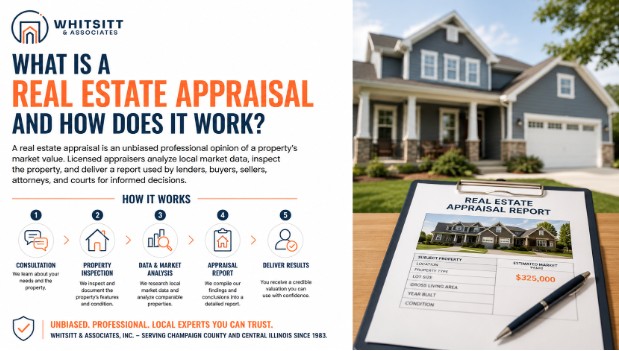
The appraisal process follows a structured sequence that typically takes three to seven business days from order to report delivery. An appraiser schedules and conducts a physical inspection, researches comparable market data, applies one or more valuation methods, and produces a written report that complies with the Uniform Standards of Professional Appraisal Practice (USPAP).
The appraiser walks the property’s interior and exterior, noting total square footage, room count, construction quality, condition, and any upgrades or deferred maintenance. Photographs document the property’s current state. A standard residential inspection takes 30 minutes to 2 hours, depending on the property’s size.
After the inspection, the appraiser reviews government records, MLS data, and recent closed sales to identify comparable properties. Most residential appraisals in Illinois use the Uniform Residential Appraisal Report (URAR) form published by Fannie Mae.
The completed report includes the value conclusion, comparable sales analysis, and adjustments made for differences between the subject property and comparables.
Licensed appraisers select from three recognized valuation approaches based on property type, available data, and the intended use of the appraisal. The sales comparison approach works best for residential properties, the cost approach suits new or unique construction, and the income capitalization approach applies to investment and commercial real estate.
| Valuation Method | Best Used For | How It Works | Common Property Types |
| Sales Comparison | Residential transactions | Compares subject to 3–6 recent similar sales with adjustments for differences | Single-family homes, condominiums, vacant land |
| Cost Approach | New construction, unique properties | Estimates land value plus reproduction cost minus depreciation | Custom homes, churches, schools, special-use buildings |
| Income Capitalization | Investment and commercial properties | Converts expected net income into value using a capitalization rate | Apartments, office buildings, retail centers, industrial |
Most residential appraisals in central Illinois rely primarily on the sales comparison approach because single-family home sales generate sufficient comparable data.
Commercial valuations often combine the income and cost approaches to triangulate value for income-producing properties.
Guessing property value puts loan approvals and legal proceedings at risk — Whitsitt & Associates delivers USPAP-compliant reports that lenders and courts accept.
A standard residential appraisal in Illinois ranges from $350 to $600, with the statewide average near $450 based on 2026 market data. Commercial appraisals start at $900 and can reach several thousand dollars for complex or large-scale properties.
The Dodd-Frank Wall Street Reform and Consumer Protection Act of 2010 requires appraisal fees to remain reasonable and customary for the geographic market.
Four primary factors determine the final cost: property type, complexity, geographic location, and turnaround time. A straightforward single-family home in Champaign requires less analysis than a complex or unique property such as a historic farmstead or mixed-use building. Rural properties that require appraisers to travel farther also carry higher fees.
Whitsitt & Associates residential appraisals start at $400 for full interior and exterior inspections, with fees ranging up to $1,000 for complex residential properties. Commercial appraisal services begin at $900.
Expert witness testimony rates range from $150 to $250 per hour for proceedings in Champaign County and surrounding jurisdictions.
Property owners, buyers, and legal professionals need appraisals for eight common situations: mortgage lending, refinancing, home purchase, pre-listing pricing, divorce property division, estate settlement, tax assessment appeals, and insurance coverage verification. Each situation requires an independent, defensible value conclusion based on current market evidence.
Federal lending regulations require appraisals for most mortgage-backed transactions. The lender orders the appraisal to confirm that the property’s value supports the requested loan amount.
Buyers benefit because an accurate appraisal prevents overpaying, and sellers use pre-listing appraisals to set competitive asking prices.
Illinois courts require appraisals in divorce cases to divide marital property equitably under the Illinois Marriage and Dissolution of Marriage Act (750 ILCS 5). Estate executors need appraisals to establish date-of-death values for probate and IRS reporting under 26 U.S.C. § 2031.
Property owners challenging county tax assessments use independent appraisals as evidence in appeal hearings before the county board of review.
An appraisal determines a property’s market value, while a home inspection evaluates its physical condition and identifies defects. These two services serve different purposes in a real estate transaction, and one does not replace the other.
Lenders require appraisals; buyers voluntarily order inspections.
| Feature | Real Estate Appraisal | Home Inspection |
| Purpose | Determines market value | Identifies structural and mechanical defects |
| Ordered By | Lender (purchase/refi) or property owner | Buyer (voluntary) |
| Professional | Licensed appraiser (IDFPR) | Licensed home inspector |
| Report Focus | Value conclusion, comparable sales, adjustments | Roof, foundation, electrical, plumbing, and HVAC condition |
| Regulatory Standard | USPAP | Illinois Home Inspector License Act (225 ILCS 441) |
| Typical Illinois Cost | $350–$600 (residential) | $300–$500 |
Appraisers note visible condition issues but do not test electrical systems, plumbing, or appliances. A thorough understanding of both services protects buyers from overpaying for a property that also needs costly repairs.
Homeowners improve appraisal outcomes by completing minor repairs, documenting recent upgrades, and providing the appraiser with a list of comparable neighborhood sales. Preparation does not guarantee a higher value, but it ensures the appraiser has complete information to produce an accurate report.
Fix visible defects such as leaking faucets, broken windows, cracked drywall, and peeling paint before the inspection.
Compile receipts and permits for renovations completed within the past five years, including kitchen remodels, roof replacements, and HVAC upgrades. A prepared checklist helps homeowners organize this documentation efficiently.
Relying on online home-value estimates instead of a professional appraisal introduces a significant margin of error.
Automated valuation models lack the physical inspection component and cannot account for interior condition, upgrades, or neighborhood nuances that a licensed appraiser evaluates firsthand.
The National Association of Realtors reports that appraisal accuracy remains essential for a fair and efficient housing market precisely because no two properties share identical characteristics.
What does a real estate appraiser look at inside a home?
A licensed appraiser evaluates room count, total living area, construction quality, interior condition, kitchen and bathroom finishes, flooring, and any visible structural issues. The appraiser also notes upgrades, such as remodeled kitchens or added square footage, that affect market value and documents the findings with photographs.
How long does a real estate appraisal take in Illinois?
A standard residential appraisal inspection takes 30 minutes to 2 hours, depending on the property’s size and complexity. The complete process from initial scheduling through final report delivery typically takes three to seven business days in central Illinois, though complex commercial properties may require additional time.
Who pays for the real estate appraisal?
The buyer pays the appraisal fee in a purchase transaction, and this cost is included in the closing costs. Homeowners pay for appraisals they order independently for refinancing, divorce, estate settlement, or tax appeals. Sellers who want a pre-listing appraisal pay the fee directly.
Can a low appraisal kill a real estate deal?
A low appraisal can prevent loan approval because lenders will not finance more than the appraised value. Buyers and sellers can renegotiate the purchase price, the buyer can pay the difference in cash, or either party can walk away from the contract.
What is the difference between assessed value and appraised value?
Assessed value represents the county’s estimate for property tax purposes, while appraised value reflects an independent, market-based opinion of what the property would sell for. These two figures often differ because assessments rely on mass appraisal techniques rather than individual property inspections.
Do I need an appraisal for a cash purchase?
There is no lender requirement for cash transactions because no mortgage is involved. Cash buyers still benefit from ordering an independent appraisal to confirm the purchase price aligns with current market value and to avoid overpaying for a property that may not support the agreed price.
How often should I get my property appraised?
Property owners benefit from a new appraisal every three to five years or whenever a significant financial event occurs. Refinancing, selling, divorce, estate transfer, and property tax assessment challenges all require current market evidence that only a professional appraisal can provide.
What happens if I disagree with my appraisal?
Property owners can request a reconsideration of value by providing the appraiser with additional comparable sales, documentation of upgrades the appraiser may have missed, or corrections to factual errors in the report. A second appraisal from a different licensed appraiser offers an independent alternative.
Does a real estate appraisal include the land?
An appraisal values the total real property, including the land and all permanent improvements, such as the house, garage, driveway, and landscaping. The cost approach separates land value from improvement value, whereas the sales comparison approach considers the property as a single unit.
What qualifications should I look for in an Illinois appraiser?
Look for an appraiser holding a Certified Residential or Certified General license from IDFPR, plus designations such as the MAI or SRA from the Appraisal Institute. Local market knowledge, USPAP compliance, and experience with your specific property type matter as much as credentials.
Inaccurate valuations lead to denied loans and overpaid tax bills — Whitsitt & Associates has protected central Illinois property owners with expert appraisals since