
Originally published: November 2026
Six primary factors determine home appraisal values in Champaign, Illinois: location and neighborhood quality, property size and condition, comparable sales data, local market conditions, home improvements, and external environmental influences.
Understanding these factors helps homeowners, buyers, and lenders anticipate how a licensed appraiser assigns market value to a specific property on a specific date.
Whitsitt & Associates has evaluated residential properties across Champaign County since 1983, applying each of these factors through USPAP-compliant methodology.
Homeowners who guess property value instead of understanding the factors appraisers measure risk can be denied loans and experience mispriced sales — request an appraisal from Whitsitt & Associates for a defensible value conclusion.
Location exerts more influence on a Champaign home’s appraised value than any other single factor. Appraisers evaluate neighborhood desirability, school district boundaries, proximity to employment centers, and access to retail and recreational amenities — all within the specific micro-market where the property sits.
The Champaign Unit 4 School District serves more than 10,000 students across 20 campuses covering Champaign, Savoy, and Bondville.
Homes within the boundaries of higher-rated schools, such as Bottenfield Elementary and Centennial High School, consistently appraise at higher prices than comparable homes in other attendance zones.
Neighborhoods like Boulder Ridge, Robeson Meadows, and Cherry Hills command premium values because buyers pay more to access those boundaries.
The University of Illinois at Urbana-Champaign anchors the local economy with approximately 56,000 students and 12,000 employees. Properties near campus — particularly in the Clark Park, downtown Champaign, and west Champaign corridors — reflect that demand in appraisal values.
Appraisers account for proximity to campus as a location adjustment when selecting and analyzing comparable sales.
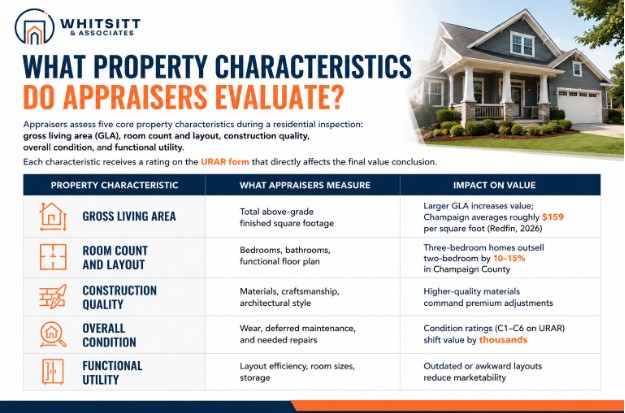
Appraisers assess five core property characteristics during a residential inspection: gross living area (GLA), room count and layout, construction quality, overall condition, and functional utility.
Each characteristic receives a rating on the URAR form that directly affects the final value conclusion.
| Property Characteristic | What Appraisers Measure | Impact on Value |
| Gross Living Area | Total above-grade finished square footage | Larger GLA increases value; Champaign averages roughly $159 per square foot (Redfin, 2026) |
| Room Count and Layout | Bedrooms, bathrooms, functional floor plan | Three-bedroom homes outsell two-bedroom homes by 10–15% in Champaign County |
| Construction Quality | Materials, craftsmanship, architectural style | Higher-quality materials command premium adjustments |
| Overall Condition | Wear, deferred maintenance, and needed repairs | Condition ratings (C1–C6 on URAR) shift value by thousands |
| Functional Utility | Layout efficiency, room sizes, storage | Outdated or awkward layouts reduce marketability |
An appraiser performing a standard interior-exterior inspection photographs each room, measures the structure, and rates these characteristics against market expectations for the Champaign area.
Comparable sales — recent closed transactions of similar properties in the same market area — provide the primary evidence of value in residential appraisals. Appraisers typically select three to six comparables that closed within the prior six to twelve months and adjust each sale for differences in size, condition, features, and location.
The Champaign-Urbana metro area’s median sale price reached approximately $228,000 in early 2026 (Redfin, March 2026), while the Federal Reserve Bank of St. Louis reported a median listing price of $309,925 for the Champaign-Urbana CBSA in April 2026.
That gap between sale and list prices signals active negotiation that appraisers must account for when reconciling comparable data.
Strong comparables share three qualities: geographic proximity to the subject property, recency of the sale date, and physical similarity in size and style.
When fewer comparables exist — common with unique or complex properties — the appraiser widens the search radius or makes larger market-based adjustments, which increases uncertainty in the value conclusion.
Relying on automated estimates without verified comparable sales data leads to pricing errors that cost homeowners thousands. Whitsitt & Associates uses local market evidence that buyers and lenders trust.
Market conditions at the time of the appraisal shape value as much as the property itself. Appraisers analyze three market indicators: inventory levels, absorption rate (average days on market), and price trends over the preceding twelve months.
Champaign County’s housing supply stood at approximately 1.6 months in early 2026, well below the six-month threshold that signals a balanced market. Homes sold in a median of 21 days on market (Movoto, May 2026).
Tight inventory and fast absorption create upward pressure on values, which appraisers reflect through market-condition adjustments applied to older comparable sales.
Interest rates also affect appraisal outcomes indirectly. Rising mortgage rates reduce buyer purchasing power, slow demand, and can soften sale prices that appraisers use as comparable evidence.
The Illinois Department of Financial and Professional Regulation (IDFPR) requires licensed appraisers to analyze and report market conditions as part of every USPAP-compliant assignment.
Documented home improvements increase appraisal value only when the market recognizes and pays for those upgrades in comparable sales. Appraisers do not assign value based on renovation costs alone — they measure the market’s reaction to the improvement through paired-sales analysis.
Kitchen remodels, bathroom updates, roof replacements, and HVAC system upgrades rank among the improvements Champaign-area buyers pay the most for in resale transactions.
A prepared homeowner who compiles receipts, permits, and contractor documentation gives the appraiser the evidence needed to support a higher condition or quality rating.
Conversely, over-improvements — renovations that exceed the neighborhood’s price ceiling — rarely recoup their full cost at appraisal. A $100,000 kitchen in a neighborhood where homes sell for $200,000 creates functional obsolescence that an appraiser must address.
Matching improvement scope to neighborhood value expectations produces the strongest return.
External factors beyond the homeowner’s control also shape appraisal values. Appraisers evaluate proximity to commercial or industrial zones, traffic volume, noise levels, flood zone designation, and environmental hazards visible from the property.
Champaign County faces a measurable flood risk: approximately 14% of properties are at high risk of severe flooding over the next 30 years (Redfin, 2026 environmental data).
Properties located within FEMA-designated flood zones require flood insurance, which reduces buyer demand and suppresses appraised values. Appraisers note flood zone status directly on the URAR form.
Zoning changes, new construction nearby, and infrastructure projects — such as road widening or utility easements — can raise or lower values depending on their impact on livability and marketability.
Property owners who rely on online estimates miss these external adjustments because automated tools cannot assess the physical surroundings as a licensed appraiser does during a site visit.
How does square footage affect a home appraisal in Champaign?
Appraisers measure above-grade gross living area and compare that figure to comparable sales. Each additional square foot adds value based on the local market rate, which averages roughly $159 per square foot in Champaign as of 2026. Below-grade finished space receives a separate, typically lower adjustment.
Do school districts really affect home appraisal values?
School district boundaries significantly influence buyer demand and sale prices in Champaign County. Appraisers select comparable sales from the same school attendance zone whenever possible because homes within higher-rated boundaries consistently sell at premium prices compared to adjacent zones.
Does a new roof increase my home’s appraised value?
A new roof improves the appraiser’s overall condition rating on the URAR form, which supports a higher value conclusion. The increase depends on what comparable homes in the neighborhood sold for with similar roof age and condition, rather than on the replacement cost alone.
How do appraisers adjust for differences between comparable sales?
Appraisers apply dollar or percentage adjustments to each comparable sale to account for measurable differences in square footage, bedroom and bathroom counts, garage capacity, lot size, condition, and location. The Uniform Standards of Professional Appraisal Practice require these adjustments to reflect actual market behavior.
Can a messy house lower my appraisal value?
Clutter and disorganization do not directly reduce appraised value, but they can prevent the appraiser from fully evaluating the property. Blocked access to attics, basements, or mechanical systems may delay the report or cause the appraiser to note limited inspection conditions.
How much does the local housing market affect my appraisal?
Market conditions directly shape appraisal values because appraisers adjust comparable sales for changes in supply, demand, and price trends over time. A seller’s market with low inventory and rising prices produces upward adjustments, while a cooling market with increasing inventory can reduce comparable-based value.
Do appraisers consider property tax assessments?
Appraisers review assessed values as background data but do not use them as a primary indicator of market value. Champaign County’s median effective property tax rate stands at 2.30%, and assessed values often differ from appraised market values because assessments use mass-appraisal methods.
What happens when there are few comparable sales in my Champaign neighborhood?
Limited comparable data forces the appraiser to expand the search area, use older sales, or apply larger adjustments — all of which increase uncertainty. Hiring an appraiser with deep local market knowledge reduces this risk because familiarity with Champaign’s micro-markets produces more defensible comparable selections.
Misjudging what drives your home’s value leads to overpriced listings and failed loan approvals — Whitsitt & Associates identifies every factor that shapes your Champaign property’s value.