

Originally published: November 2026
Preparing for a home appraisal requires completing visible repairs, compiling upgrade documentation, clearing access to every room and system, and enhancing curb appeal before the appraiser’s arrival.
Preparation does not inflate value, but thorough readiness ensures the appraiser captures every feature and condition detail that supports an accurate, defensible market valuation.
Mark S. Whitsitt, SRA, Residential Supervisor at Whitsitt & Associates, has conducted residential appraisals across central Illinois since 2006. Unprepared properties remain the leading cause of delayed reports and overlooked value.
Unprepared properties lead to lower condition ratings, delayed reports, and preventable value losses — request an appraisal from Whitsitt & Associates and know exactly what to have ready.
Unprepared homeowners risk lower condition ratings, delayed reports, and preventable value losses when the appraiser arrives to find unresolved defects and inaccessible spaces.
Homeowners should begin preparing seven to ten days before the scheduled appraisal by addressing repairs, compiling upgrade documentation, clearing physical access to every inspectable area, and improving curb appeal.
Treating the appointment as a structured evaluation rather than a casual drop-in produces more complete and accurate reports.
Prioritize tasks that affect what the appraiser sees and measures: fix visible damage first, organize documents second, and address curb appeal last. A structured preparation checklist prevents last-minute scrambling that leaves important items unfinished.
Confirm the appointment date and time, ask whether any specific access requirements exist (gate codes, locked outbuildings, attic ladder locations), and mention any improvements the appraiser should see.
Licensed appraisers in Illinois follow the Uniform Standards of Professional Appraisal Practice (USPAP), which requires independent judgment, but providing factual information about the property helps, not hinders, accuracy.
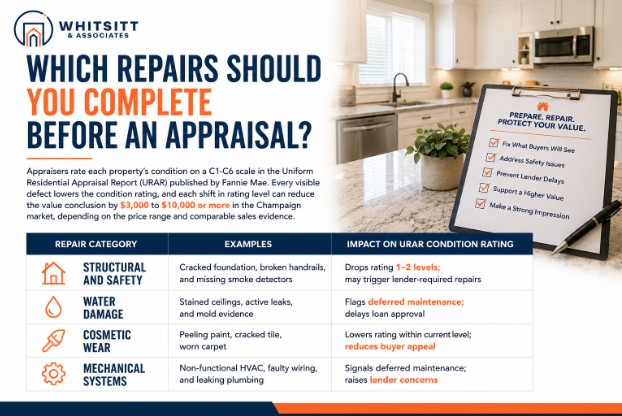
Appraisers rate each property’s condition on a C1-C6 scale in the Uniform Residential Appraisal Report (URAR) published by Fannie Mae. Every visible defect lowers the condition rating, and each shift in rating level can reduce the value conclusion by $3,000 to $10,000 or more in the Champaign market, depending on the price range and comparable sales evidence.
| Repair Category | Examples | Impact on URAR Condition Rating |
| Structural and safety | Cracked foundation, broken handrails, and missing smoke detectors | Drops rating 1–2 levels; may trigger lender-required repairs |
| Water damage | Stained ceilings, active leaks, and mold evidence | Flags deferred maintenance; delays loan approval |
| Cosmetic wear | Peeling paint, cracked tile, worn carpet | Lowers rating within current level; reduces buyer appeal |
| Mechanical systems | Non-functional HVAC, faulty wiring, and leaking plumbing | Signals deferred maintenance; raises lender concerns |
Focus repair efforts on structural and safety items first, as those defects trigger mandatory lender conditions that halt the transaction. Cosmetic repairs matter less individually but add up to a lower overall impression.
Replacing broken outlet covers, tightening loose doorknobs, and patching minor defects takes minimal time but improves the appraiser’s condition assessment.
Homeowners should prepare renovation receipts, building permits, contractor invoices, survey or plat maps, and HOA documentation before the appraiser arrives. Organized records provide the appraiser with verifiable evidence to support higher-quality and condition ratings on the URAR form, which directly strengthens the value conclusion.
Compile receipts and contractor invoices for every improvement completed within the past five years, including kitchen remodels, bathroom renovations, roof replacements, HVAC installations, window upgrades, and flooring projects. Include building permits where the municipality requires them.
Champaign and Urbana require building permits for structural modifications, electrical work, and plumbing changes — homeowners should confirm specific permit requirements with the local building department before the appraiser arrives.
| Document Type | What To Include | Why the Appraiser Needs It |
| Renovation receipts | Contractor name, cost, completion date, scope of work | Supports condition and quality rating adjustments on the URAR form |
| Building permits | Permit number, issuing municipality, inspection approval | Verifies work met code and was legally completed |
| Survey or plat map | Boundary lines, easements, and lot dimensions | Confirms lot size and identifies encroachments or access limitations |
| HOA documentation | Monthly dues, special assessments, restrictions | Affects marketability and buyer demand in comparable analysis |
Appraisers use this documentation to support adjustments they make on the URAR form. Without permit and receipt documentation, the appraiser may rate a fully renovated kitchen the same as an original kitchen because the upgrade was not visible or verified.
A clear understanding of appraisal factors helps homeowners anticipate which documents matter most.
Incomplete documentation forces appraisers to estimate condition and quality without evidence — Whitsitt & Associates walks central Illinois homeowners through exactly what records to gather for a thorough, lender-ready report.
Homeowners should mow and edge the lawn, trim overgrown landscaping, clear debris from walkways, and repair visible exterior damage before the appraiser arrives.
Exterior condition photographs appear on the first page of the URAR form, and the overall property impression establishes the appraiser’s baseline condition assessment before the front door opens.
Clean gutters of visible leaf buildup and address seasonal concerns specific to central Illinois: spring and summer inspections benefit from fresh mulch and planted beds, while fall and winter appointments require clearing snow, salting walkways, and ensuring visible house numbers so the appraiser can locate the property.
Power-wash siding, clean the front entry, and repair any visible exterior damage, such as cracked steps, peeling trim paint, or loose handrails. The exterior condition directly affects the appraiser’s C-rating and signals how well the homeowner maintains the overall property.
A standard residential appraisal inspection in central Illinois takes 30 minutes to two hours, depending on property size and complexity. The appraiser measures the exterior footprint, photographs each room, notes room count and layout, evaluates construction quality, and rates overall condition.
The appraiser walks through every room, opens bedroom closets to confirm room-count classifications, checks kitchen and bathroom finishes, inspects the condition of the flooring, and photographs any visible damage or deferred maintenance.
Keep all interior doors unlocked and lights on. Secure pets in a contained area so the appraiser can move freely through the entire property.
The appraiser checks the age and condition of the HVAC system, water heater, electrical panel, and plumbing. Clear access to the attic hatch, basement stairs, crawl space entry, and utility closets.
Blocked access points result in “unable to inspect” notations on the report, which lenders flag as incomplete and may require a follow-up visit.
The mistakes that most often undermine appraisal outcomes include leaving visible damage unrepaired, blocking access to inspection areas, failing to disclose renovations, following the appraiser room to room, relying on online estimates as a benchmark, and over-improving beyond the neighborhood’s price ceiling.
Hovering during the inspection creates discomfort and can bias the process. Greet the appraiser, offer the documentation package, mention any specific features or improvements, and then step aside.
The Appraisal Institute emphasizes that appraiser independence produces the most defensible results — let the professional work without pressure.
Over-improvement ranks among the most expensive mistakes. A $60,000 kitchen renovation in a Champaign neighborhood where the median sale price sits near $228,000 (Redfin, 2026) exceeds what comparable buyers pay, and appraisers cannot assign value to the market that does not support.
Matching renovation scope to neighborhood value norms protects the homeowner’s return.
How far in advance should I start preparing for a home appraisal?
Start preparation seven to ten days before the scheduled inspection. Prioritize structural and safety repairs during the first three days, compile documentation during days four through six, and address curb appeal and cleaning during the final two days before the appraiser arrives.
Does cleaning my house actually affect the appraisal value?
Cleaning does not directly affect the appraised value, but a clean property allows the appraiser to evaluate features without distraction and to document the condition accurately. Clutter that blocks access to rooms, attics, or mechanical systems can result in incomplete inspection notations that lenders flag as deficient.
Should I be present during the home appraisal inspection?
Homeowners may remain on the property, but should avoid following the appraiser room to room. Greet the appraiser, hand over the documentation package, mention any notable upgrades, and allow the professional to complete the inspection independently without interruption.
What renovations add the most value to a Champaign home appraisal?
Kitchen remodels, bathroom updates, roof replacements, and HVAC system upgrades rank among the improvements that Champaign-area comparable sales most consistently reflect in higher sale prices. Appraisers measure market reaction to improvements through paired sales analysis rather than assigning value based on renovation cost alone.
Can I challenge my appraisal if the value comes in low?
Property owners can submit a request for reconsideration of value to the appraiser through the lender. Include additional comparable sales the appraiser may have missed, documentation of upgrades not reflected in the report, or corrections to factual errors, such as incorrect square footage or room count.
What happens if the appraiser cannot access part of my home?
Blocked attics, locked crawl spaces, and inaccessible utility areas result in limited-inspection notations on the URAR form. Most lenders require a follow-up visit to complete the inspection before approving the loan, which delays the transaction and may incur an additional fee for the return trip.
Do I need to provide comparable sales to the appraiser?
Homeowners are not required to provide comparable sales, but offering a list of recent neighborhood transactions helps the appraiser verify market activity. Licensed appraisers conduct independent research through MLS and public records, so homeowner-provided data supplements rather than replace professional analysis.
How does a low appraisal affect my mortgage or refinance?
A low appraisal can prevent loan approval because lenders will not finance more than the appraised value. Buyers can renegotiate the price, cover the gap with cash, or request a second appraisal. Refinancing borrowers may receive lower loan amounts or less favorable terms.
Skipping preparation costs central Illinois homeowners lower condition ratings and preventable report delays — Whitsitt & Associates has guided property owners through the appraisal process since 1983.