

Originally published: November 2026
A rate-and-term refinance appraisal is an independent opinion of a home’s current market value, prepared for a lender resetting the interest rate or term without advancing new cash.
The appraiser evaluates condition, gross living area, and closed comparable sales — not credit scores, income, or payoff balances.
Fannie Mae classifies these transactions as limited cash-out refinances, and the appraised value sets the loan-to-value ratio that determines the new loan price. Champaign homeowners who order an appraisal early get the same market evidence the lender’s appraiser will weigh.
A low refinance appraisal can cost thousands over the life of the loan. Request an appraisal from Whitsitt & Associates in Champaign.
A rate-and-term refinance appraisal values the property securing a loan that changes the interest rate, the repayment term, or both, without returning cash to the borrower.
Fannie Mae groups these loans under limited cash-out refinance transactions in Selling Guide B2-1.3-02, which restricts incidental cash back and fixes the collateral documentation the lender must collect.
Illinois assigns the work to credentialed professionals: a Certified Residential Real Estate Appraiser or Certified General Real Estate Appraiser licensed through the Illinois Department of Financial and Professional Regulation.
The appraiser owes impartiality to the lender-client and the public, never to the loan outcome.
That independence explains why the appraisal process runs through the lender or an appraisal management company rather than the homeowner, so the value conclusion survives underwriting review.
The appraiser measures the home, rates condition and quality, and photographs every room, each exterior elevation, and the street scene.
A refinance inspection carries the same scope as a purchase inspection, because the lender needs identical evidence of collateral condition before releasing funds.
| Inspection Area | What the Appraiser Records | Why It Moves Value |
| Exterior and site | Roof age, siding condition, drainage, site size, garage capacity | Site size and covered parking produce measurable grid adjustments |
| Gross living area | Exterior measurements, above-grade room count, basement finish recorded separately | Below-grade finished space is credited apart from above-grade area |
| Condition and quality | Kitchen and bath updates, flooring, renovation dates, materials | UAD condition ratings C1–C6 set the baseline for every comparison |
| Mechanical systems | Furnace, central air, water heater, electrical service capacity | Pending replacement costs transfer directly into buyer offers |
| Functional items | Room layout, bedroom egress, attic and crawlspace access | Functional obsolescence narrows the buyer pool and reduces marketability |
Deferred maintenance and unpermitted additions surface during the appraisal inspection first, and both carry forward into the condition rating that anchors every later adjustment.
A homeowner who documents completed repairs and permit approvals before the visit protects the condition rating the entire report rests on.
The appraiser selects closed sales that competed directly with the subject property, then adjusts each sale for measurable differences.
Champaign County divides into distinct submarkets—Champaign, Urbana, Savoy, Mahomet, and surrounding townships—and sales from one rarely support value in another.
Five criteria govern comparable selection and the market value conclusion on a Central Illinois refinance assignment:
Paired-sales evidence drives the final conclusion, which is why an appraiser’s value frequently differs from an automated estimate built on county records alone.
A homeowner relying on an automated estimate to predict refinance eligibility can misjudge the loan-to-value ratio that sets pricing.
Refinance timelines collapse when a value question surfaces late in underwriting. Order an appraisal from Whitsitt & Associates, appraising Champaign County since 1983.
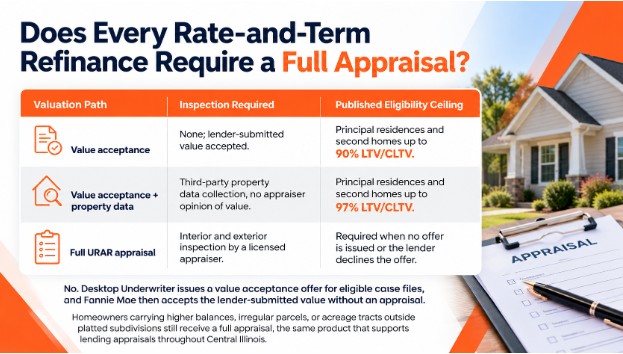
No. Desktop Underwriter issues a value acceptance offer for eligible case files, and Fannie Mae then accepts the lender-submitted value without an appraisal.
Value acceptance generally requires a prior appraisal for the subject property in Collateral Underwriter data, which excludes homes never financed through a conventional loan.
Fannie Mae publishes eligibility ceilings by transaction type and puts the average appraisal cost saved at roughly $550 per loan through June 2026.
| Valuation Path | Inspection Required | Published Eligibility Ceiling |
| Value acceptance | None; lender-submitted value accepted | Principal residences and second homes up to 90% LTV/CLTV |
| Value acceptance + property data | Third-party property data collection, no appraiser opinion of value | Principal residences and second homes up to 97% LTV/CLTV |
| Full URAR appraisal | Interior and exterior inspection by a licensed appraiser | Required when no offer is issued, or the lender declines the offer |
Homeowners carrying higher balances, irregular parcels, or acreage tracts outside platted subdivisions still receive a full appraisal, the same product that supports lending appraisals throughout Central Illinois.
The report itself is changing. Fannie Mae and Freddie Mac are retiring the static form set, including Form 1004, and replacing it with one redesigned report form that adapts its layout to the property type being appraised. Adoption is optional through most of 2026 and mandatory for appraisals delivered on or after November 2, 2026.
The redesigned report, built on the Uniform Appraisal Dataset 3.6 standard, captures property characteristics as structured data rather than narrative commentary.
Condition and quality ratings extend across all residential property types under the new standard.
Champaign homeowners refinancing late in 2026 should expect a report that looks different from a 2024 appraisal while reaching value through the same sales comparison analysis.
A value below expectations raises the loan-to-value ratio, which can reprice the loan, trigger mortgage insurance, or stop the refinance entirely.
Most low values trace to three causes: comparable sales that predate a market shift, unpermitted square footage excluded from the measurement, or condition issues the homeowner discounted.
The Federal Housing Finance Agency directed Fannie Mae and Freddie Mac to publish borrower-initiated reconsideration of value policies, standardizing a process lenders once handled individually.
The lender must disclose the process, collect the request, and route it to the original appraiser, whose written response must address the low appraised value the homeowner identified.
A reconsideration succeeds on specifics: closed sales the appraiser did not analyze, permit records for finished space, or a factual correction to room count or site size.
Under Regulation B, 12 CFR 1002.14, the creditor must deliver a copy of the appraisal promptly upon completion or at least three business days before closing, giving homeowners the document they need to identify those errors. Reviewing that report closely matters more than contacting the appraiser about a target number, which independence rules prohibit.
What does an appraiser look for in a refinance appraisal?
A refinance appraiser inspects the home’s condition, measures gross living area, photographs each room and the exterior, then analyzes recent closed sales of similar Champaign-area homes. Loan terms, credit history, and payoff balances fall entirely outside the appraisal assignment and never enter the report.
Does a rate-and-term refinance always require an appraisal?
No. Fannie Mae may issue a value acceptance offer that waives the appraisal on eligible limited cash-out refinances. When no offer is issued, or the lender declines it, a full interior appraisal is required. Eligibility depends on the loan-to-value ratio and prior appraisal data.
How long does a refinance appraisal take in Champaign, IL?
Inspection of a typical Champaign single-family home usually takes under an hour. Report delivery then depends on assignment complexity, comparable sales research, and the lender’s own review queue. Complex or acreage properties require additional research time before we finalize the report.
Does the homeowner get a copy of the refinance appraisal?
Yes. Regulation B, 12 CFR 1002.14, requires the creditor to deliver a copy of each appraisal promptly upon completion, or three business days before closing, whichever comes first. The creditor cannot charge for providing that copy. Applicants may waive the timing requirement.
Can a homeowner be present during the refinance appraisal inspection?
Yes. Homeowners may accompany the appraiser and point out improvements, permits, or recent system replacements. Appraiser independence rules prohibit any attempt to influence the value conclusion, so factual documentation helps while target numbers and pressure do not. Permit records carry the most weight.
What hurts a refinance appraisal the most?
Deferred maintenance hurts refinance values most: failing roofs, dated mechanical systems, water intrusion, and unfinished projects. Unpermitted additions also reduce credited gross living area, because appraisers measure and rate only space that meets local building standards. Cluttered or inaccessible rooms can also delay the inspection.
Can a homeowner dispute a low refinance appraisal?
Yes. Fannie Mae, Freddie Mac, and FHA require lenders to accept borrower-initiated reconsideration-of-value requests. A homeowner submits specific closed sales or factual corrections through the lender, and the original appraiser reviews the evidence and responds in writing. Opinions alone carry no weight.
Does a rate-and-term refinance appraisal remove PMI?
Not automatically. A rate-and-term refinance replaces the existing loan, so mortgage insurance depends on the new loan-to-value ratio. Homeowners staying in the current loan pursue PMI removal through a separate appraisal ordered under the servicer’s own requirements. That appraisal follows a different scope of work.
An unsupported value conclusion trails a homeowner through every later loan decision. Schedule an appraisal with Whitsitt & Associates at (217) 356-7605.