
Originally published: July 2026
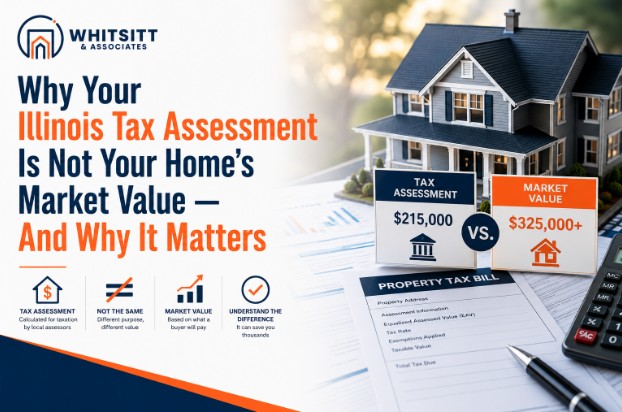
Illinois tax assessed value and market value are two separate figures calculated by two separate processes, and confusing them costs homeowners money.
Your county assessor sets assessed value using a statutory fraction of estimated market value for tax billing purposes; what a qualified appraiser determines through a USPAP-compliant analysis reflects what your property would actually sell for today.
Overpaying Illinois property taxes every year because your assessed value is wrong? Whitsitt & Associates provides USPAP-compliant appraisals used by Champaign-Urbana homeowners to challenge incorrect assessments and recover overpaid taxes.
Illinois townships and county assessors do not appraise every home the way a licensed appraiser does. Instead, the assessor’s office uses mass appraisal techniques — computer-assisted models, neighborhood sales data, and property record cards — to estimate market value for the entire jurisdiction at once.
Under 35 ILCS 200/9-145, most residential property in Illinois is assessed at 33.33% of the assessor’s estimated fair market value as of 2026. That fraction is called the level of assessment. The result is your assessed value.
Assessment levels vary across townships within a county. The Illinois Department of Revenue applies a multiplier — called the state equalization factor or “equalizer” — to bring every county’s median assessed value to the statutory 33.33% level.
The result after applying this multiplier is your Equalized Assessed Value (EAV), and it is your EAV, not your market value, that your tax rate is applied to.
| Term | What It Means | Who Sets It |
| Assessed Value | Assessor’s estimated market value × 33.33% | Township or county assessor |
| Equalized Assessed Value (EAV) | Assessed value × state equalization factor | Illinois Department of Revenue |
| Market Value | Price a willing buyer pays a willing seller in an arm’s-length transaction | Licensed appraiser or open market |
| Tax Bill | EAV × local tax rate ÷ 100 | Taxing districts (school, fire, county) |
The assessor’s mass appraisal model is built for speed across thousands of parcels — not for accuracy on any individual home. Several structural factors cause the two figures to separate over time.
Illinois counties reassess on different cycles. Champaign County reassesses annually, but many downstate counties reassess every four years. A home that appreciated significantly between cycles will carry an outdated assessed value — sometimes lower than true market value, sometimes higher if the local market softened after the last reassessment.
Property record cards used by most Illinois assessors reflect data collected during the last physical inspection, which may be years old. Finished basements, additions, and significant deterioration that occurred since the last visit are often not captured, producing assessed values that do not reflect the current condition.
Mass appraisal models select comparable sales across wide geographic pools and apply statistical adjustments. A licensed appraiser selecting comparables for a specific property uses a much tighter geographic and temporal range, applies condition and feature adjustments manually, and reconciles to a single point estimate with documented reasoning.
The methodologies are not equivalent.
| Factor | Mass Appraisal (Assessor) | USPAP Appraisal (Whitsitt & Associates) |
| Scope | Entire jurisdiction | Single property |
| Comparable selection | Statistical, broad geographic pool | Manual, tightest defensible range |
| Physical inspection | Periodic, exterior-only common | Interior and exterior, current condition |
| Purpose | Tax billing | Market value opinion |
| Legal defensibility for appeal | Not sufficient alone | Primary evidence standard |
Illinois property tax law requires that assessors value property at fair cash value, defined under 35 ILCS 200/1-50 as the amount for which a property can be sold in the due course of business and trade, not under duress, within a reasonable period. This is the same concept as market value used in appraisal practice.
The legal standard exists on paper. Whether the assessor’s mass appraisal model produces a number that actually reflects fair cash value for your specific property is a separate question — and the answer is frequently no.
When a Champaign County homeowner files a complaint with the Board of Review under 35 ILCS 200/16-55, the burden of proof rests on the property owner to demonstrate that the assessed value does not reflect fair cash value.
A certified appraisal is the strongest form of evidence that the burden can be met.

If your EAV implies a market value of $280,000 but a licensed appraiser determines your home’s current market value is $240,000, you are paying taxes on $40,000 of phantom value.
At a 7% composite tax rate, that is $933 per year in excess tax, compounding every year until corrected.
The tax appeal appraisal process at Whitsitt & Associates begins with a USPAP-compliant appraisal that establishes current market value — the evidentiary foundation a Board of Review requires to grant a reduction.
A lender will not use your assessed value to approve a mortgage. The bank orders an independent appraisal. If the lender’s appraiser comes in below the contract price, the deal is at risk.
Understanding the gap between your assessed value and likely appraised value before listing gives you accurate expectations and negotiating room.
Probate courts in Illinois require a fair market value opinion for real property included in an estate, not an assessed value. Under 755 ILCS 5/28-2, the inventory and appraisement filed with the court must reflect current market value.
An assessor’s figure will not satisfy the court or co-heirs disputing distribution. A retrospective or current appraisal for probate by a credentialed appraiser is the correct instrument.
Champaign County property owners can access current assessed values through the Champaign County GIS Consortium at ccgisc.org or by contacting the Champaign County Assessor’s Office directly. Your annual tax bill also states your EAV in the assessment detail section.
To calculate the market value, your EAV implies:
Step 1: Locate your EAV on your tax bill or county property record.
Step 2: Divide your EAV by the state equalization factor for your county (published annually by the Illinois Department of Revenue at tax.illinois.gov), substituting Champaign County’s current published factor from tax.illinois.gov.
Step 3: Divide the result by 0.3333 to convert the assessed value back to the implied market value.
Example: EAV of $82,000 ÷ equalization factor of 1.000 = assessed value of $82,000 ÷ 0.3333 = implied market value of $246,000.
If that implied market value is higher than what comparable homes in your neighborhood are actually selling for, you are a strong candidate for a tax appeal.
A USPAP-compliant appraisal provides a documented, defensible market value opinion based on a current physical inspection and manually selected comparables — neither of which the assessor’s mass appraisal model produces for your individual property.
Compliance with the Uniform Standards of Professional Appraisal Practice (USPAP) is required of every appraiser licensed under 225 ILCS 458.
The appraisal report includes a current interior and exterior inspection, a manually selected and adjusted comparable sales grid, a reconciled value conclusion with documented reasoning, and the appraiser’s certification and license number. Champaign County’s Board of Review accepts this format as primary evidence in assessment appeal hearings.
The residential appraisal process at Whitsitt & Associates adheres to USPAP standards for every assignment. Stephen D. Whitsitt, MAI, SRA has provided appraisal services across Champaign, Piatt, Douglas, and surrounding counties since the firm’s founding.
Tax deadlines in Illinois are fixed. Champaign County Board of Review complaints must be filed within 30 days of the publication of the 2026 assessment roll, typically in the summer. Missing that window means waiting another full year.
Paying taxes on a value your home cannot support? Request an appraisal from the firm and obtain the documentation you need to challenge your assessment before the filing deadline.
Is the tax assessed value the same as the market value in Illinois?
No. Illinois assessors estimate market value and then apply a 33.33% assessment ratio to produce assessed value. The assessor’s market value estimate may itself be inaccurate, and the assessed value is always lower than any correct market value figure by design.
How do I find out if my Illinois home is over-assessed?
Divide your EAV by the county equalization factor, then divide by 0.3333 to calculate the market value your assessment implies. Compare that figure to recent sale prices of similar homes in your neighborhood. If your implied market value is higher than comparable sales, you likely have grounds for an appeal.
Can I use my tax assessment to price my home for sale?
No. A tax assessment reflects a statutory fraction of an administratively estimated value and is not a reliable indicator of what a buyer will pay. Sellers who price from assessed value frequently misprice their property, and a current market value appraisal from a licensed appraiser provides the correct baseline.
What is the equalization factor in Illinois, and how does it affect my taxes?
The equalization factor, also called the multiplier, is applied by the Illinois Department of Revenue to adjust each county’s assessed values to the statutory 33.33% level. A factor above 1.000 increases your EAV; a factor below 1.000 decreases it. The factor is recalculated annually and published at tax.illinois.gov.
How long does a property tax appeal take in Illinois?
Champaign County Board of Review complaints must be filed within 30 days of the publication of the assessment roll. Decisions are typically issued within 60 to 90 days of that deadline. The Illinois Property Tax Appeal Board (PTAB) process can take 18 to 36 months when county relief is insufficient.
What evidence does the Champaign County Board of Review accept?
The Board of Review accepts USPAP-compliant appraisals, recent comparable sales data, and property record card corrections. A certified appraisal is the primary form of evidence accepted by the Board of Review and typically produces more consistent outcomes than comparable sales submitted alone.
Does a lower assessed value always mean lower taxes?
A lower EAV reduces your tax bill proportionally only when tax rates hold constant. Tax rates are set by dividing each district’s levy by total EAV in that district, so if overall EAV falls, rates may rise. Reducing your individual EAV still lowers your proportionate share of the total levy.
How often does Illinois reassess property?
Reassessment frequency varies by county. Champaign County reassesses annually. Many downstate Illinois counties reassess on a four-year cycle under 35 ILCS 200/9-215. The state equalization factor is recalculated every year regardless of the local reassessment cycle.
What is the difference between the Board of Review and PTAB?
The Board of Review is the county-level body that hears initial assessment complaints under 35 ILCS 200/16-55. PTAB — the Illinois Property Tax Appeal Board — is the state administrative tribunal that hears appeals from Board of Review decisions when county relief is insufficient.
Can an appraisal from Whitsitt & Associates be used for both a tax appeal and an estate matter at the same time?
Appraisal reports are written for a specific intended use and intended user. A tax appeal assignment and an estate settlement assignment serve different purposes and typically require separate reports. Whitsitt & Associates can advise on the correct scope of work during the initial consultation.
Every year your assessment goes unchallenged, the overpayment compounds. Whitsitt & Associates delivers the USPAP-compliant market value opinion that Champaign County homeowners need to correct inaccurate assessments and stop overpaying property taxes today.