

Originally published: September 2026
When a Central Illinois lender requires a full refinance appraisal, a licensed appraiser inspects the property, verifies square footage and condition, and supports a current market value with recent comparable sales — the figure the lender uses to set the loan-to-value ratio for the new loan.
Lenders order the appraisal to confirm the collateral supports the requested loan amount before underwriting proceeds.
Homeowners can review how Whitsitt & Associates structures a residential appraisal before their lender submits the order.
Homeowners refinancing who want to confirm scope and eligibility before underwriting can contact Whitsitt & Associates, Inc. to coordinate the appraisal assignment with their lender.
Lenders require a refinance appraisal that meets Fannie Mae, Freddie Mac, or FHA guidelines, depending on which agency ultimately purchases the loan.
A refinance appraisal is a USPAP-compliant valuation report that states a property’s market value as of a specific effective date, supported by an inspection and a set of comparable sales.
Reports completed by Mark S. Whitsitt, SRA, or another residential-credentialed appraiser at the firm are prepared to meet these standards from the outset.
The refinance appraisal process in Central Illinois follows a defined sequence from lender order to underwriting review.
A lender or its assigned appraisal management company orders the appraisal once the loan application clears initial processing, then an appraiser contacts the homeowner directly to schedule the property inspection.
| Stage | What Happens | Who’s Involved |
| Order & Assignment | Lender (or its AMC) submits the order; appraiser accepts and schedules the visit | Lender, appraiser |
| Property Inspection | Appraiser measures square footage, photographs interior/exterior, notes condition | Appraiser, homeowner |
| Comparable Sales Analysis | Appraiser pulls recent Central Illinois sales and adjusts for differences | Appraiser |
| Report Delivery | Completed report goes to the lender for underwriting review | Appraiser, lender, underwriter |
Homeowners who want a walkthrough of what the appraiser checks during the inspection can review what to expect during a home appraisal inspection before the visit is scheduled.
Whitsitt & Associates’ published turnaround guidance places a standard Central Illinois refinance appraisal at 7 to 14 days from order to report delivery, though rural properties or homes needing additional comparable-sales research can extend that window.
Rural townships surrounding Champaign County typically have fewer arm’s-length sales within a tight comparable radius than denser areas like Champaign or Urbana.
That scarcity may require an appraiser to expand the search radius or widen the sale-date window to find adequate support, which adds research time before the report is finalized—a factor homeowners on a rate-lock deadline should account for early.
Central Illinois homeowners on a lender-imposed deadline can review steps that speed up appraisal delivery before the order goes out.
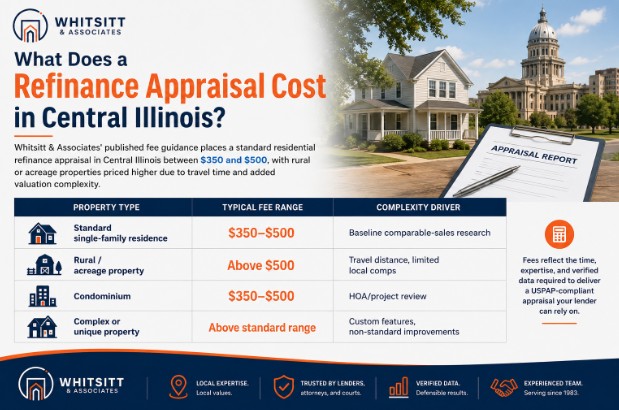
Whitsitt & Associates’ published fee guidance places a standard residential refinance appraisal in Central Illinois between $350 and $500, with rural or acreage properties priced higher due to travel time and added valuation complexity.
| Property Type | Typical Fee Range | Complexity Driver |
| Standard single-family residence | $350–$500 | Baseline comparable-sales research |
| Rural / acreage property | Above $500 | Travel distance, limited local comps |
| Condominium | $350–$500 | HOA/project review |
| Complex or unique property | Above standard range | Custom features, non-standard improvements |
Owners of rural or unusually configured properties can review how complex property appraisals are scoped before requesting a fee quote.
On most conventional first mortgages, a loan-to-value ratio above 80% triggers private mortgage insurance unless another permitted credit-enhancement structure applies — a threshold refinancing homeowners should confirm with their lender, since eligible loan-to-value limits vary by transaction and property type, particularly for cash-out refinances.
Homeowners who prepare a property before the inspection help ensure the appraiser has complete, accurate information, which supports a well-documented value conclusion.
Preparation centers on documentation, access, and visible condition — not on influencing the appraiser’s independent judgment, which federal appraiser-independence rules prohibit.
Homeowners who want a fuller walkthrough of prep steps can read how to boost a home appraisal outcome and review what to ask a home appraiser before the scheduled visit.
A refinance appraisal that comes in below the expected value can reduce the available loan amount, raise the loan-to-value ratio, or trigger private mortgage insurance the homeowner did not budget for.
A low appraisal does not automatically end a refinance; several corrective paths remain available.
Homeowners who want the full list of factors that can produce a low result can review common reasons for low appraisals before the inspection takes place.
Not every Illinois refinance requires a full appraisal. Fannie Mae’s Value Acceptance program allows certain eligible refinance transactions to skip a traditional appraisal entirely when the lender’s data meets the agency’s collateral-risk thresholds, using Fannie Mae’s database of millions of appraisals in Collateral Underwriter in combination with proprietary analytics to determine the minimum level of required collateral due diligence.
Eligibility depends on the loan program, the borrower’s equity position, and the property type — not on borrower request alone.
Homeowners removing private mortgage insurance from an existing loan typically still need a standard residential appraisal to document current value against the original loan balance; details are covered on the PMI removal appraisal page.
Fannie Mae and Freddie Mac also began transitioning lenders to the redesigned Uniform Residential Appraisal Report under UAD 3.6, with all new appraisal submissions to the Uniform Collateral Data Portal required to use the updated format beginning November 2, 2026 — a format change that does not affect homeowner-facing requirements but does affect the report structure appraisers deliver to lenders.
Borrowers who receive a completed appraisal gain a federal right to review it before signing: Regulation B requires creditors to provide copies of appraisal reports and other written home-value estimates to consumers promptly, or three days before closing, whichever is earlier.
Homeowners who want the general appraisal process explained from the buyer’s side can also review the appraisal process for buyers, which covers many of the same inspection and comparable-sales steps a refinance appraisal follows.
Central Illinois homeowners ready to confirm scope and begin the process can contact Whitsitt & Associates, Inc. by calling (217) 356-7605.
How soon before closing must a refinance appraisal be delivered to the borrower? Federal Regulation B requires lenders to deliver a copy of the completed appraisal promptly upon completion or at least three business days before closing, whichever comes first, unless the borrower waives that timing requirement in writing beforehand.
Can a homeowner choose which appraiser completes a refinance appraisal? On agency-backed loans, appraiser-independence rules require the lender to assign the appraiser through an arm’s-length process, so borrowers cannot pay or directly select the assignment. Homeowners can still ask their lender whether a specific local firm sits on its approved panel.
Does a refinance appraisal expire if the loan process takes longer than expected? Yes. Fannie Mae requires the appraisal’s effective date to remain within four months of the note date without an update, and within 12 months with one; after that, a new appraisal is required.
What loan-to-value ratio triggers private mortgage insurance on a refinance? On most conventional first mortgages, a loan-to-value ratio above 80% triggers private mortgage insurance unless another permitted credit-enhancement structure applies. Eligible loan-to-value limits vary by transaction and property type, so refinancing homeowners should confirm the exact threshold with their lender.
Can a homeowner be present during the refinance appraisal inspection? Yes. Homeowners are generally expected to grant the appraiser interior and exterior access and may be present to answer factual questions about the property, though they may not influence the value conclusion.
What documents should a homeowner have ready for a refinance appraisal? Homeowners should gather permits and receipts for renovations, a recent survey if available, and any documentation of system replacements or repairs completed since the previous appraisal or the original purchase closing.
Does Fannie Mae’s Value Acceptance program (formerly called an appraisal waiver) mean no inspection occurs at all? Not always. Some Value Acceptance transactions pair a property-data collection visit with a full appraiser inspection, depending on the specific eligibility path the loan qualifies for.
How does a rural Central Illinois property affect refinance appraisal cost and timeline? Rural properties typically cost more than the standard $350–$500 range due to added travel time and fewer nearby comparable sales, which can also extend the delivery timeline beyond the typical 7-to-14-day window.
What can a homeowner do if a refinance appraisal comes in lower than expected? A homeowner can request a Reconsideration of Value through the lender, supply additional comparable sales the report may have missed, adjust the loan amount, or bring additional cash to close to offset the gap.
Is a refinance appraisal different from a purchase appraisal? The core inspection and valuation approach is similar, though assignment conditions, intended use, and reporting requirements can differ. A refinance appraisal also has no purchase contract price to anchor against, which places more weight on comparable-sales selection and current condition.