

Originally published: September 2026
Appraised value is the key input a lender uses to calculate how much a Central Illinois homeowner can borrow in a cash-out refinance.
The lender applies its maximum loan-to-value percentage — generally up to 80% for a one-unit primary residence — to the appraised value, then finalizes the loan amount based on that calculation along with the borrower’s own underwriting factors.
Homeowners can review the refinance appraisal process before requesting a quote.
Homeowners weighing a cash-out refinance can contact the firm to confirm scope and ask whether it sits on their lender’s approved appraiser panel.
A cash-out refinance appraisal is a USPAP-compliant valuation report that establishes a property’s current market value as an independent opinion, separate from the lending decision itself.
The lender uses that value, together with its loan-to-value limits and the borrower’s underwriting profile, to determine the maximum new loan amount and the cash available after paying off the existing mortgage.
Unlike a rate-and-term refinance, which simply replaces the existing loan, a cash-out refinance increases the loan balance — which is why the appraised value carries more weight in the outcome than it does in a rate-and-term transaction.
Appraisers such as Mark S. Whitsitt, SRA, complete these reports as part of the firm’s broader residential appraisal services for Central Illinois homeowners.
An appraiser determines one thing: the property’s current market value, supported by an inspection and comparable sales, delivered as an independent professional opinion.
A lender determines everything downstream of that value — the maximum loan-to-value percentage the loan program allows, whether the borrower’s credit and income qualify, and the final loan amount and cash proceeds after costs.
| Determined By | What It Covers |
| Appraiser | Property condition, comparable sales, and the supported market value opinion |
| Lender / Loan Program | Maximum LTV percentage, borrower qualification, final loan amount, cash proceeds |
That separation exists by design: federal appraiser-independence rules keep the value opinion free from influence by loan officers or borrowers, so the number the lender calculates from it stays reliable.
The lender multiplies the appraised value by its maximum allowed loan-to-value ratio, then subtracts the existing mortgage payoff and closing costs to arrive at the cash calculation available to the borrower.
The table below illustrates the mechanics using a hypothetical Central Illinois property; it isolates the loan-to-value effect only and is not a projection of final lender approval, net proceeds, or any specific homeowner’s outcome.
| Appraised Value | Max LTV | Maximum New Loan | Existing Mortgage Payoff | Illustrative Cash Available |
| $250,000 | 80% | $200,000 | $140,000 | ~$60,000 before closing costs |
| $230,000 | 80% | $184,000 | $140,000 | ~$44,000 before closing costs |
| $210,000 | 80% | $168,000 | $140,000 | ~$28,000 before closing costs |
The example shows how a $40,000 swing in appraised value can change the loan-to-value calculation by roughly $32,000 at an 80% cap. Credit-score-based pricing adjustments, lender overlays, and final underwriting decisions will change the actual number in a real transaction.
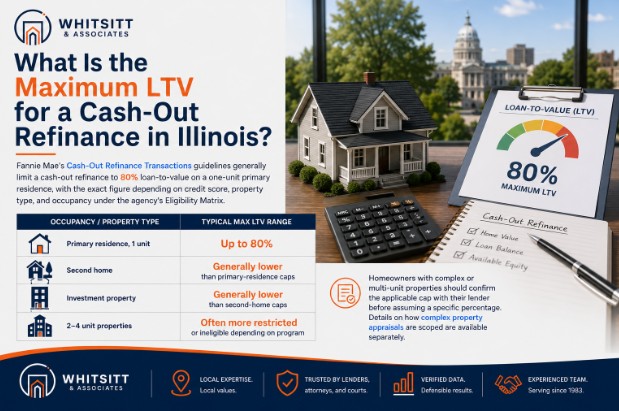
Fannie Mae’s Cash-Out Refinance Transactions guidelines generally limit a cash-out refinance to 80% loan-to-value on a one-unit primary residence, with the exact figure depending on credit score, property type, and occupancy under the agency’s Eligibility Matrix.
| Occupancy / Property Type | Typical Max LTV Range |
| Primary residence, 1 unit | Up to 80% |
| Second home | Generally lower than primary-residence caps |
| Investment property | Generally lower than second-home caps |
| 2–4 unit properties | Often more restricted or ineligible depending on program |
Homeowners with complex or multi-unit properties should confirm the applicable cap with their lender before assuming a specific percentage; details on how complex property appraisals are scoped are available separately.
Property type changes both the maximum loan-to-value ratio a lender will allow and the comparable-sales pool an appraiser can draw from to support a value conclusion.
Rural Central Illinois properties with acreage, outbuildings, or limited nearby sales activity can offer a narrower band of usable comparables, which adds research complexity to the appraisal—a factor that affects the time an appraisal takes, not necessarily the value it reaches.
An appraisal that comes in below expectations directly reduces the loan-to-value calculation available to the lender, since that calculation is based on the appraised value rather than the homeowner’s estimate.
The lack of recent comparable sales in a given neighborhood is one of the most common reasons an appraisal comes in below expectations, particularly in slower-moving or rural Central Illinois markets.
Deferred maintenance, unpermitted work, and a property condition that falls short of nearby comparable sales can also affect the supportable value.
Homeowners facing this outcome are not without options:
A full breakdown of common causes is available on the Reasons for Low Appraisals page.
Homeowners preparing a property before the inspection can also help the process go smoothly. Reviewing preparation tips beforehand helps ensure the appraiser has complete, accurate information about renovations, repairs, and property condition.
Not necessarily. Fannie Mae’s Value Acceptance program can apply to eligible cash-out refinance transactions, but the lender decides whether to use it, and doing so generally requires a qualifying prior appraisal for the property already on file in the agency’s Collateral Underwriter database, along with an Approve/Eligible recommendation through Desktop Underwriter.
Many cash-out transactions don’t have a qualifying prior appraisal on file, so a traditional appraisal establishes the value the loan amount will be based on. Homeowners curious about what that inspection involves can review the appraisal inspection process.
Borrowers who do receive a traditional appraisal have a federal right to review it: Regulation B requires lenders to deliver a copy of the completed report promptly, or at least three business days before closing, whichever comes first.
Illinois-licensed appraisers who prepare these reports hold credentials issued by IDFPR and complete continuing education requirements to maintain that license.
Homeowners with questions about the process can also review appraisal preparation questions worth asking before scheduling.
Central Illinois homeowners planning a cash-out refinance can contact the firm at (217) 356-7605 to confirm scope and ask whether it’s on their lender’s approved panel.
How does appraised value affect how much I can borrow in a cash-out refinance?
The lender uses the appraised value to calculate the maximum loan-to-value amount, typically up to 80% for a one-unit primary residence. A higher appraisal widens that calculation; a lower one narrows it — the borrower’s underwriting profile then determines the final loan amount.
What is the maximum LTV for a cash-out refinance in Illinois?
Fannie Mae’s conventional guidelines generally cap a cash-out refinance at 80% loan-to-value for a one-unit primary residence. Credit score, property type, and occupancy affect the exact figure under the agency’s Eligibility Matrix, and second homes or investment properties usually face lower caps.
Can a low appraisal reduce the cash-out amount I was expecting?
Yes. Because the lender’s loan-to-value calculation is based on the appraised figure, a lower-than-expected result narrows that calculation. This holds even when the homeowner’s own estimate of the property’s worth was higher than the appraiser’s supported conclusion.
Does a cash-out refinance always require a full appraisal?
Not always. Fannie Mae’s Value Acceptance program can apply to eligible cash-out transactions when a qualifying prior appraisal already exists in the agency’s database, and the lender chooses to exercise the offer. Without a qualifying prior appraisal on file, a traditional appraisal is typically required.
Why do rural Central Illinois properties sometimes present appraisal challenges for cash-out purposes?
Rural properties often have fewer nearby comparable sales, which adds research complexity and can require expanding the search radius or widening the sale-date window. That complexity affects how long the appraisal takes and how it’s supported, not automatically the value it reaches.
Can I challenge a cash-out refinance appraisal if the value seems too low?
Yes. Borrowers can request a Reconsideration of Value through their lender, supplying additional comparable sales or documentation the original report may have missed. The lender then reviews the request and decides whether the appraisal’s value conclusion should be revised upward.
Does a second home or investment property have a different cash-out LTV limit?
Yes. Fannie Mae generally sets lower maximum loan-to-value ratios for second homes and investment properties than for a primary residence. That lower cap narrows the loan-to-value calculation relative to the same appraised value, even on otherwise comparable properties.
How long before closing must I receive a copy of my cash-out refinance appraisal?
Federal Regulation B requires lenders to provide a copy of the completed appraisal promptly upon completion, or at least three business days before closing, whichever comes earlier. Borrowers can waive that timing requirement, but only by doing so in writing before closing.
What can I do before the appraisal to support the strongest possible value?
Homeowners can gather documentation of renovations and repairs, clear access to all areas of the home, and complete minor visible repairs. These steps help the appraiser work from complete, accurate information without directly influencing the independent value conclusion.