

Originally published: September 2026
Some Illinois refinances can skip a traditional appraisal through a lender-decided alternative program.
Options include Fannie Mae’s Value Acceptance, Freddie Mac’s Automated Collateral Evaluation, an FHA Streamline Refinance, or a VA Interest Rate Reduction Refinance Loan.
Eligibility depends on the loan program, prior appraisal history, and the lender’s risk assessment—not on a homeowner’s request.
Homeowners can review the refinance appraisal process that applies when a traditional appraisal is required.
An appraisal waiver, more precisely called an appraisal alternative, is a lender’s decision to rely on existing data instead of ordering a new appraisal to establish a property’s value for a refinance.
The lender — not the borrower — makes this determination, using automated underwriting systems that assess collateral risk based on prior appraisal data, public records, and market history.
Appraisers such as Mark S. Whitsitt, SRA, complete a traditional appraisal whenever the lender’s system doesn’t return an eligible waiver, as part of the firm’s broader residential appraisal services for Central Illinois homeowners.
The lender decides, using the automated underwriting system tied to the loan program the refinance will be sold through. A borrower cannot request or select an appraisal waiver directly; the system evaluates the loan file and returns an eligibility result, which the lender then chooses whether to accept.
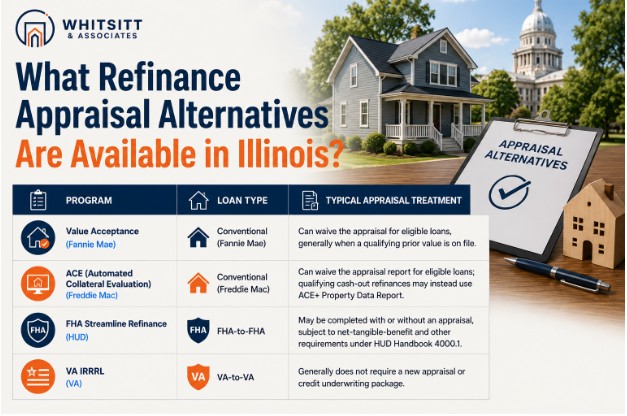
Illinois homeowners refinancing through different loan programs encounter different appraisal alternatives, since each government-sponsored enterprise or agency sets its own rules.
| Program | Loan Type | Typical Appraisal Treatment |
| Value Acceptance | Conventional (Fannie Mae) | Can waive the appraisal for eligible loans, generally when a qualifying prior value is on file |
| ACE (Automated Collateral Evaluation) | Conventional (Freddie Mac) | Can waive the appraisal report for eligible loans; qualifying cash-out refinances may instead use ACE+ Property Data Report |
| FHA Streamline Refinance | FHA-to-FHA | May be completed with or without an appraisal, subject to net-tangible-benefit and other requirements under HUD Handbook 4000.1 |
| VA IRRRL | VA-to-VA | Generally does not require a new appraisal or credit underwriting package |
Homeowners weighing a cash-out transaction specifically can also review how appraised value affects cash-out borrowing limits, since cash-out refinances follow different waiver rules than rate-and-term refinances.
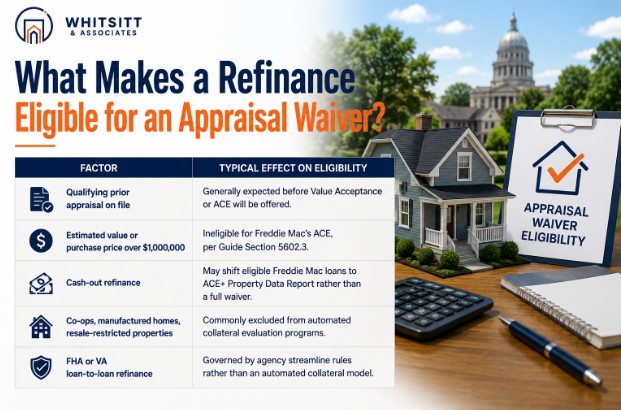
Eligibility for a conventional appraisal alternative generally depends on the lender’s automated system finding a reliable prior value for the property, along with the loan meeting the program’s risk criteria.
Fannie Mae’s Value Acceptance and Freddie Mac’s ACE are separate programs with their own rules, though both generally require a qualifying prior appraisal on file before offering a waiver.
Certain transaction types and property categories are excluded regardless of loan program.
| Factor | Typical Effect on Eligibility |
| Qualifying prior appraisal on file | Generally expected before Value Acceptance or ACE will be offered |
| Estimated value or purchase price over $1,000,000 | Ineligible for Freddie Mac’s ACE, per Guide Section 5602.3 |
| Cash-out refinance | May shift eligible Freddie Mac loans to ACE+ Property Data Report rather than a full waiver |
| Co-ops, manufactured homes, resale-restricted properties | Commonly excluded from automated collateral evaluation programs |
| FHA or VA loan-to-loan refinance | Governed by agency streamline rules rather than an automated collateral model |
In the firm’s experience, rural, acreage, or otherwise complex properties are less likely to have a reliable prior appraisal on file for an automated system to draw from, since these programs depend on comparable data the model can score with confidence.
A traditional appraisal still applies whenever the lender’s automated system doesn’t return an eligible waiver result, or when the lender chooses to order one despite an available alternative.
A homeowner refinancing a property with no qualifying prior appraisal on file, or a property type outside a program’s waiver criteria, should expect a standard appraisal inspection as part of the process.
Homeowners on a rate-lock deadline can also review steps that speed appraisal delivery once a traditional appraisal is confirmed.
Borrowers who do receive a traditional appraisal have a federal right to review it: Regulation B requires lenders to deliver a copy of the completed report promptly, or at least three business days before closing, whichever comes first.
Illinois-licensed appraisers who complete these reports hold credentials issued by IDFPR.
Skipping the appraisal can save the borrower a fee and shorten the refinance timeline, but it also means no independent inspection confirms the property’s current condition or value.
Homeowners should also note that “skipping the appraisal” isn’t always all-or-nothing: some transactions substitute a property-data collection visit rather than eliminating an on-site look at the home entirely, which is a different outcome from a full waiver with no visit at all.
A homeowner who has made improvements since the last appraisal on file — a kitchen remodel, a room addition, or a new roof — may actually prefer a new appraisal, since an automated valuation can’t account for work it has no record of.
Homeowners weighing whether to request a traditional appraisal can review common reasons for low appraisals and preparation tips that help support the strongest possible outcome either way.
Homeowners whose lender confirms a traditional appraisal is required can contact Whitsitt & Associates, Inc. at (217) 356-7605 with general questions about scope and fees.
Can I refinance without an appraisal in Illinois?
Some Illinois refinances can skip a traditional appraisal through Fannie Mae’s Value Acceptance, Freddie Mac’s ACE, an FHA Streamline Refinance, or a VA IRRRL. Eligibility depends on the loan program and the lender’s automated underwriting result, not on the homeowner’s preference.
Who decides if my refinance qualifies for an appraisal waiver?
The lender’s automated underwriting system makes this determination, based on the loan program, prior appraisal data already on file, and the property’s risk profile. Borrowers cannot request or select an appraisal waiver directly; the lender ultimately decides whether to accept or decline the system’s offer.
Does Fannie Mae’s Value Acceptance apply to every conventional refinance?
No. Value Acceptance generally looks for a qualifying prior appraisal already in Fannie Mae’s Collateral Underwriter database, along with an Approve/Eligible recommendation through Desktop Underwriter. Loans without a reliable prior value on file typically don’t receive a waiver offer and instead proceed to a traditional appraisal.
Does a cash-out refinance qualify for Freddie Mac’s ACE program?
Cash-out refinances that meet Freddie Mac’s requirements may qualify for ACE+ Property Data Report instead of a full appraisal waiver. This means a trained data collector visits the property in place of a licensed appraiser, gathering condition details the automated model uses to confirm value.
Does an FHA Streamline Refinance always skip the appraisal?
Not always. HUD allows FHA Streamline Refinances to be completed with or without an appraisal, per HUD Handbook 4000.1, but the program also carries its own net-tangible-benefit and underwriting conditions, and individual lenders may still order an appraisal depending on the transaction.
Does a VA IRRRL require a home appraisal?
Generally no. A VA Interest Rate Reduction Refinance Loan typically does not require a new appraisal or credit underwriting package because it refinances an existing VA loan into a new VA loan for eligible veterans, service members, and surviving spouses with VA loan entitlement.
What property types are usually excluded from appraisal waiver programs?
Co-ops, manufactured homes, and properties with resale restrictions such as community land trusts are commonly excluded from automated collateral evaluation programs. Freddie Mac’s ACE program also excludes mortgages with an estimated value or purchase price over $1,000,000.
Is it better to get a traditional appraisal even if my loan qualifies for a waiver?
It can be, particularly after finishing a kitchen remodel, a room addition, or a new roof that an automated system wouldn’t have on record. A traditional appraisal documents current condition and value directly, though whether that report serves a later purpose depends on that lender’s or party’s own requirements.
Can I challenge an appraisal waiver decision the way I could challenge a low appraisal?
Generally no. An automated value estimate doesn’t go through the same Reconsideration of Value process available for a traditional appraisal, so homeowners who disagree with the estimate have fewer formal options, though asking the lender whether a traditional appraisal can be obtained instead remains a reasonable next step.