

Originally published: November 2026
C3 and C4 are adjacent condition ratings on the six-point scale appraisers apply to every home financed with a conventional mortgage. The difference is maintenance timing, not loan eligibility.
C3 marks a home whose short-lived components have already been replaced. C4 marks one where the furnace, roof covering, or water heater is nearing the end of its service life.
Both ratings remain eligible for an as-is appraisal. Central Illinois homeowners ordering an appraisal can see which rating the report assigned and why.
A condition rating assigned without documentation costs Champaign homeowners equity on paper. Request an appraisal from Whitsitt & Associates for an independent opinion.
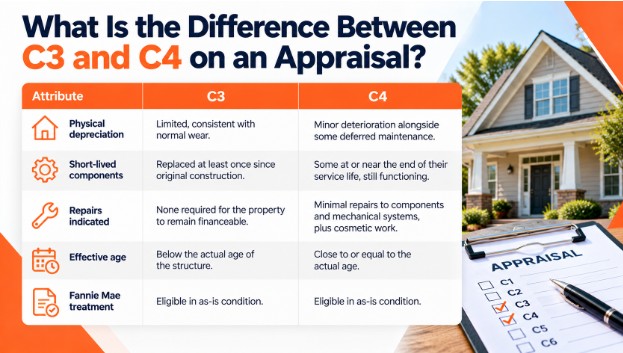
C3 describes a well-maintained dwelling carrying limited depreciation, where some major components have been updated, and the structure needs no repairs.
C4 describes a dwelling that has been adequately maintained but shows minor deferred maintenance and requires only minimal component repairs and cosmetic work.
Fannie Mae publishes both definitions in Selling Guide B4-1.3-06, updated June 4, 2025.
Every appraisal submitted through the Uniform Collateral Data Portal must carry one of the six ratings.
The rating travels with the data rather than with the lender, which is why the appraisal process produces a consistent reading of a Champaign County home across every institution reviewing it.
| Attribute | C3 | C4 |
| Physical depreciation | Limited, consistent with normal wear | Minor deterioration alongside some deferred maintenance |
| Short-lived components | Replaced at least once since original construction | Some at or near the end of their service life, still functioning |
| Repairs indicated | None required for the property to remain financeable | Minimal repairs to components and mechanical systems, plus cosmetic work |
| Effective age | Below the actual age of the structure | Close to or equal to the actual age |
| Fannie Mae treatment | Eligible in as-is condition | Eligible in as-is condition |
The last row is the one most homeowners come looking for. Moving from C3 to C4 changes the narrative the appraiser writes about the home, not the loan’s eligibility, and the market value conclusion still rests on comparable sales rather than the rating code.
The appraiser weighs where the home sits in the replacement cycle of its short-lived components. A home in its first cycle of replacing appliances, floor coverings, and HVAC equipment reads C3; a home where those same components are reaching the end of their physical life reads C4, even when every one of them still works.
The judgment covers the whole dwelling, not any single area. The appraisal inspection records across the full structure determine the rating, and Fannie Mae prohibits moving the rating up or down because of one superior or inferior room.
Observations that typically separate C4 from C3 in an older Central Illinois home:
No single observation in that list sets the rating on its own. The appraiser reconciles all five into one reading, which is why a homeowner cannot reverse-engineer a rating from a single repair.
Refinance and sale timelines stall when condition questions reach underwriting unanswered. Schedule an appraisal with Whitsitt & Associates, appraising Champaign County since 1983.
No. Properties rated C1 through C5 are eligible in as-is condition, as long as existing conditions do not affect safety, soundness, or structural integrity.
Only C6 stops delivery of the loan to Fannie Mae, and a C6 property must be appraised subject to repairs reaching a minimum C5. A C4 rating on a Champaign home therefore carries the same financing status as a C3.
A separate question matters more to many refinancing homeowners: whether the lender orders an appraisal that assigns a rating at all.
| Valuation Path | Condition Rating Assigned | What the Lender Receives |
| Value acceptance | None | The lender-submitted value, accepted with no appraisal performed |
| Value acceptance + property data | None from an appraiser | Third-party property data collection without an opinion of value |
| Full appraisal | One rating from C1 through C6 | A complete report rating both the subject and every comparable sale |
Desktop Underwriter issues value acceptance offers on eligible transactions, and a homeowner whose loan receives one never sees a condition rating because no appraiser inspects the property.
The distinction between C3 and C4 matters only when a full appraisal is ordered, which is why lending appraisals rarely hinge on the gap between the two ratings.
A homeowner can challenge a rating, though only through the lender and only with documentary evidence. The Federal Housing Finance Agency directed Fannie Mae and Freddie Mac to adopt borrower-initiated reconsideration of value policies, which give homeowners a standardized route to submit evidence that the original appraiser reviews and answers in writing.
Evidence that moves a rating is documentary rather than argumentative: a dated invoice for a furnace replaced two years ago, a permit for a finished basement, or photographs of a crawlspace the appraiser could not reach.
Component replacements completed without records produce ratings homeowners consider too harsh, and the same gap sits behind many low appraisals that surface late in a transaction.
One limit holds in every case. A rating attached to a completed sale stays fixed when that transaction is later used as a comparable, so a successful reconsideration changes the current assignment without rewriting the record of an earlier one.
Documentation converts invisible maintenance into recorded maintenance. Appraisers carry no responsibility for hidden or unapparent conditions, so a replaced sewer line or re-shingled roof affects the rating only when the homeowner can prove it.
Dated receipts for mechanical replacements, permits for structural work, and warranty paperwork for recent installations give the appraiser verifiable dates rather than estimates.
Thoughtful appraisal preparation also means clearing access to attics, crawlspaces, and electrical panels, since an area the appraiser cannot enter cannot support a favorable reading.
Under Regulation B, the creditor must deliver a copy of the appraisal promptly upon completion or three business days before closing, whichever comes first, at no charge to the applicant. That copy shows the subject rating beside the rating of each comparable sale.
Comparing those ratings is a worthwhile check before deciding whether a reconsideration request is warranted. Confirming that the signer holds an active credential with the Illinois Department of Financial and Professional Regulation completes that review.
What is the difference between C3 and C4 on an appraisal?
C3 describes a well-maintained home with limited depreciation, where short-lived components have been replaced at least once. C4 describes adequate maintenance with minor deferred items, where some components sit at or near the end of their service life but still function.
Is C4 a bad condition rating?
No. C4 reflects an adequately maintained home that needs only minimal repairs to building components and cosmetic work. Fannie Mae accepts C4 properties in as-is condition, so the rating doesn’t create an obstacle to conventional financing on its own. Only C6 stops the loan.
Does a C4 rating mean the appraised value comes in lower?
Not by itself. The appraiser adjusts for condition differences within the sales comparison grid rather than applying a deduction tied to the rating code. A C4 home compared against C4 sales requires no condition adjustment. Comparable selection drives the difference.
What pushes a home from C3 down to C4?
Short-lived components reaching the end of their service life push a home to C4. Aging furnaces, worn roof coverings, dated water heaters, and accumulated cosmetic repairs move the estimated effective age closer to the structure’s actual age. No single item decides the rating.
Can one room change a home’s condition rating?
No. The appraiser rates the dwelling holistically, so one superior or inferior room does not move the overall rating. C6 is the single exception: a deficiency affecting safety, soundness, or structural integrity rates the entire dwelling C6. That rule applies to every property type.
Can a homeowner get a C4 rating changed to C3?
Only through the lender’s reconsideration of value process, and only with documentary evidence. Permits, dated invoices for component replacement, and photographs of areas the appraiser could not access support the request. The original appraiser reviews and responds in writing. Market opinions carry no weight.
Do refinances get a condition rating?
Only when an appraisal is performed. Desktop Underwriter can issue a value acceptance offer that waives the appraisal on eligible transactions, and no condition rating is assigned in that case. A full appraisal always carries one. Eligibility depends on loan-to-value and prior data.
Where does the condition rating appear in the report?
The rating appears in the improvements section and again in the sales comparison grid, alongside ratings for every comparable sale. Homeowners receive a copy of the completed appraisal from the creditor and can compare the subject rating directly against the comparables.
Does a C4 rating stay with a Champaign County home permanently?
The rating attaches to a specific transaction, not to the property forever. A later appraisal after documented improvements can support C3. The earlier C4, however, remains fixed whenever that original sale is used as a comparable in another report. Both records coexist without conflict.
One rating category separates a clean file from a lender review. Order an appraisal from Whitsitt & Associates at (217) 356-7605.