

Originally published: November 2026
A C3 condition rating is the appraiser’s standardized description of a home that is well maintained and shows only limited physical depreciation from normal wear.
Fannie Mae’s Uniform Appraisal Dataset requires a rating from C1 to C6 on every lending appraisal, and C3 sits in the upper-middle of that scale.
The rating describes condition and does not deduct a fixed amount from value. Champaign County homeowners can compare the rating against the comparable sales in the report before requesting an appraisal of their own.
A misapplied condition rating follows a Champaign home into every future appraisal. Request an appraisal from Whitsitt & Associates for an independent read.
C3 identifies a home that has been kept up, carries limited depreciation from ordinary use, and needs no repairs to remain financeable.
Fannie Mae’s definition points to a dwelling where some major building components have been updated or rehabilitated, though not all of them have. Every appraisal submitted through the Uniform Collateral Data Portal carries one of these ratings, as Fannie Mae requires in Selling Guide B4-1.1-06.
The practical marker is effective age. A C3 property shows an estimated effective age below its actual age, because short-lived components have been replaced at least once since construction.
Consider an Urbana ranch built in the mid-1980s whose furnace, roof covering, and flooring have all been replaced since then: that home reads younger than its calendar age, and that gap separates C3 from the ratings below it.
The appraiser assigns the condition rating on an absolute basis, judging the property on its own merits as of the effective date rather than against the surrounding neighborhood.
That rule keeps the rating portable across lenders and review systems, which is why the appraisal process produces comparable data instead of a local opinion that shifts from one subdivision to the next.
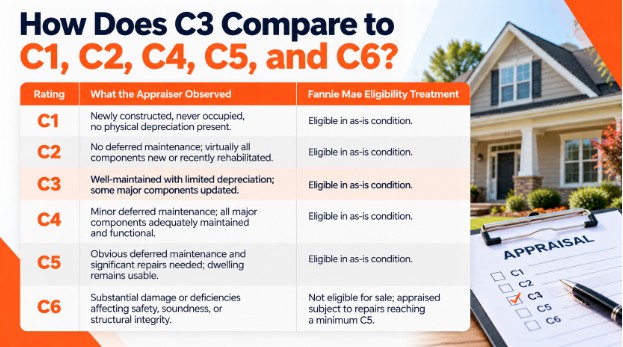
The scale runs from new construction at C1 to safety-affecting deficiencies at C6, and only the bottom rung carries an eligibility consequence. Every rating from C1 through C5 permits an as-is appraisal, provided existing conditions do not affect safety, soundness, or structural integrity.
That distinction matters more to a Central Illinois homeowner than the rating number itself, and it governs how lending appraisals move through underwriting.
| Rating | What the Appraiser Observed | Fannie Mae Eligibility Treatment |
| C1 | Newly constructed, never occupied, no physical depreciation present | Eligible in as-is condition |
| C2 | No deferred maintenance; virtually all components new or recently rehabilitated | Eligible in as-is condition |
| C3 | Well-maintained with limited depreciation; some major components updated | Eligible in as-is condition |
| C4 | Minor deferred maintenance; all major components adequately maintained and functional | Eligible in as-is condition |
| C5 | Obvious deferred maintenance and significant repairs needed; dwelling remains usable | Eligible in as-is condition |
| C6 | Substantial damage or deficiencies affecting safety, soundness, or structural integrity | Not eligible for sale; appraised subject to repairs reaching a minimum C5 |
Fannie Mae publishes these definitions in Selling Guide B4-1.3-06, updated June 4, 2025. Minor items such as worn carpet, a small plumbing leak, or cracked window glass get reported in the appraisal without forcing a repair condition, so a homeowner facing a punch list of cosmetic items has no financing problem to solve.
UAD 3.6, the modernized dataset required for appraisals delivered to Fannie Mae and Freddie Mac on or after November 2, 2026, applies condition and quality ratings across all residential property types, including manufactured housing.
The C1 through C6 scale and its eligibility consequences carry over unchanged to the redesigned report.
The rating emerges from a complete visual inspection of the accessible areas, not from a checklist score.
The appraiser records what the walkthrough reveals about the home’s condition and reconciles those observations into one holistic judgment covering the dwelling as a whole.
Observations that push a Central Illinois home toward C3 rather than C4 include:
Appraisers carry no responsibility for hidden or unapparent conditions, which places documentation squarely with the homeowner.
Dated receipts and permit records turn an invisible improvement into a documented one, so a furnace replaced three winters ago influences the rating instead of going unnoticed.
Condition questions surface late and stall closings across Central Illinois. Schedule an appraisal with Whitsitt & Associates, which has appraised Champaign County since 1983.
No. The rating is descriptive data, not an arithmetic deduction. The appraiser determines value through the sales comparison approach, comparing the subject to closed sales with their own condition ratings and adjusting for measurable differences between them.
Fannie Mae states directly that properties sharing a rating may still require an adjustment. A C3 home with a fully remodeled kitchen and a C3 home with original but well-kept cabinetry occupy the same rating band while commanding different prices.
The appraiser explains that the adjustment is made in the report rather than relying on the rating code to carry the difference, which is how a defensible market value conclusion gets built.
The rating drives comparability. Automated review systems flag an appraisal whose subject rating sits far from the ratings of the selected comparables, and an unexplained gap invites lender review.
A correct C3 therefore protects the file from a delay that costs the homeowner closing time, even though it moves no dollars on its own.
The appraiser records the level of updating separately from the condition rating, and the two answer different questions. Condition addresses upkeep and depreciation; updating addresses modernization.
A spotless, meticulously maintained 1972 colonial in Champaign can be rated C3 and described as Not Updated in the same report without contradiction, which is where appraisal preparation efforts are often misdirected.
| Level of Updating | What It Describes | Example in an Older Central Illinois Home |
| Not Updated | Little or no modernization; properties over fifteen years old qualify when appliances, fixtures, and finishes remain predominantly dated | Original cabinetry, fixtures, and flooring still functioning in a 1970s ranch |
| Updated | Changes limited in scope and cost that bring an area to current market expectations without structural alteration | Replaced countertops, refinished cabinet fronts, and new flooring within the existing kitchen footprint |
| Remodeled | Significant finish or structural change achieved through complete replacement or expansion | Gutted bathroom with relocated plumbing, or walls removed to open a kitchen into an adjoining room |
Homeowners weighing renovation spending before a sale or refinance gain more from this table than from the rating scale, because the updating level is where discretionary dollars actually register in the report.
C5 and C6 diverge sharply despite sitting next to each other on the scale. A C5 property shows obvious deferred maintenance and needs significant repairs, yet remains usable as a residence and stays eligible for an as-is appraisal.
A C6 property carries deficiencies severe enough to compromise safety, soundness, or structural integrity.
The consequence is categorical. If any portion of the dwelling warrants C6, the entire dwelling is rated C6, and a loan secured by that property cannot be sold to Fannie Mae.
The appraisal must instead be completed subject to completion of the specific repairs, with a resulting rating of at least C5, after which the lender confirms the work under the completion requirements in Selling Guide B4-1.2-05.
Where the appraiser lacks the qualifications to evaluate a defect, the report is completed subject to inspection by a qualified professional, and the lender decides whether that inspection is required.
Evidence of infestation, dampness, or abnormal settlement triggers its own requirement: the appraisal must address the effect on both value and marketability.
These mechanisms explain the low appraised values homeowners experience as sudden, because a single structural finding reorders the entire transaction.
A homeowner can challenge a rating, though only through the lender. The Federal Housing Finance Agency directed Fannie Mae and Freddie Mac to adopt borrower-initiated reconsideration of value policies, giving homeowners a standardized route to submit evidence that the original appraiser then reviews and answers in writing.
Evidence that moves a rating is documentary: permits for work the appraiser could not see, invoices dated to the replacement of a major component, or photographs of an area that access problems kept off the walkthrough.
Opinions about the neighborhood or the lender’s timeline change nothing. One structural limit applies in every case — a rating attached to a completed sale transaction stays fixed when that sale is later used as a comparable, so an appraiser revising a current assignment cannot retroactively restate history.
Illinois credentialing adds a verification step available to any homeowner. Certified Residential and Certified General Real Estate Appraisers hold licenses issued by the Illinois Department of Financial and Professional Regulation, and confirming an active credential before challenging a report establishes who actually signed it.
Homeowners ordering independent Champaign appraisals for estate, divorce, or pre-listing purposes receive the same rating framework applied outside the lending channel, so the condition analysis holds up whether or not a mortgage is involved.
What does C3 mean on a home appraisal?
C3 means the appraiser found a well-maintained home with limited depreciation from normal wear. Some major components may have been updated, though not all. The rating signals adequate upkeep rather than a deficiency, and it keeps the property eligible in as-is condition.
Is a C3 rating good or bad?
C3 is a favorable rating. The rating describes a home kept in good repair with no significant deferred maintenance. Properties rated C1 through C5 remain eligible in as-is condition under Fannie Mae policy, so a C3 creates no financing obstacle on its own.
What is the difference between C3 and C4?
C3 describes a home in its first cycle of replacing short-lived components, with an effective age below its actual age. C4 describes adequate maintenance where some components sit near the end of their useful life but still function. Minor repairs separate the two.
Does a C3 rating reduce the appraised value?
No. The condition rating is a descriptive code, not a deduction. Value moves through adjustments in the sales comparison grid, where the appraiser compares the subject against sales carrying their own condition ratings and reconciles the resulting differences. Two C3 homes can still differ.
Can a home be rated C3 if the kitchen is original?
Yes. The rating reflects a holistic view of the whole dwelling, not one superior or inferior room. An original kitchen in a well-maintained home supports a C3 rating, though the appraiser records the updating level separately as Not Updated. That distinction appears in the report.
Does a C3 rating stay with the property?
Yes, for that specific transaction. When a sale rated C3 later appears as a comparable in another appraisal, the rating stays C3. Appraisers cannot revise a prior transaction’s rating to suit a new assignment or a different market. Consistency across reports is the reason.
What triggers a C6 rating?
Deficiencies severe enough to affect safety, soundness, or structural integrity trigger a C6. Compromised foundations, hazardous wiring, and substantial damage qualify. One such deficiency rates the entire dwelling C6, and the loan cannot be sold to Fannie Mae until repairs reach C5.
Do condition ratings apply to manufactured homes in Illinois?
Yes. Under UAD 3.6, condition and quality ratings apply to all residential property types, including manufactured housing. The same C1 through C6 scale applies, and the same safety, soundness, and structural standards govern eligibility for sale to Fannie Mae. Illinois follows the same national standard.
Can a homeowner dispute a condition rating?
Yes, through the lender’s reconsideration of value process. A homeowner submits permit records, repair invoices, or photographs documenting components the appraiser could not observe. The original appraiser reviews the evidence and issues a written response confirming or revising the rating.
What is the difference between the condition rating and the quality rating?
Condition ratings from C1 to C6 describe upkeep and depreciation. Quality ratings from Q1 to Q6 describe original construction, materials, and workmanship. A well-maintained budget-built home can carry a high condition rating alongside a modest quality rating. Both appear on every lending report.
An unexplained condition rating costs homeowners leverage with lenders and buyers alike. Order an appraisal from Whitsitt & Associates at (217) 356-7605.