
Originally published: July 2026
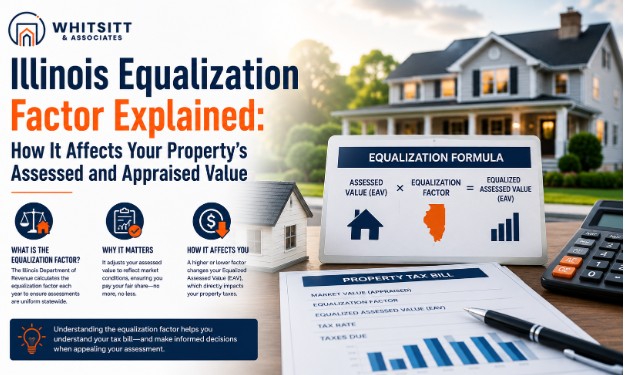
The Illinois equalization factor is a state-issued multiplier applied to every county’s assessed values to bring them to the statutory 33.33% level of market value. Your county assessor estimates your home’s value and applies the assessment ratio.
The Illinois Department of Revenue then applies the equalization factor to produce your Equalized Assessed Value (EAV) — the figure your property tax bill is actually calculated from.
Your EAV may not reflect what your property is actually worth. Whitsitt & Associates provides USPAP-compliant appraisals for Champaign County property owners who need a documented market value opinion to evaluate or challenge their assessed value.
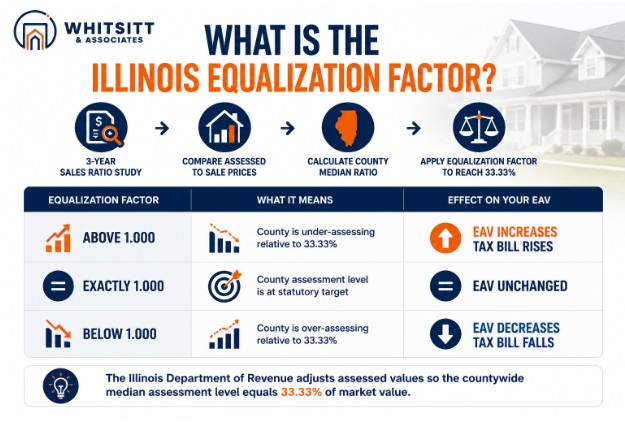
The Illinois equalization factor is a multiplier that the Illinois Department of Revenue applies to a county’s assessed values to bring the countywide median assessment level to the statutory 33.33% of market value required under 35 ILCS 200/17-5.
Each county receives its own factor, calculated annually based on three years of sales ratio studies comparing assessed values to actual sale prices across the county.
A sales ratio study measures how closely a county’s assessed values track actual market transactions.
When the median ratio falls below 33.33% — meaning assessors are undervaluing property relative to market — the Department of Revenue issues a factor above 1.000 to multiply assessed values upward.
When the median ratio exceeds 33.33%, the factor falls below 1.000, pushing values down.
| Equalization Factor | What It Means | Effect on Your EAV |
| Above 1.000 | The county is under-assessing relative to 33.33% | EAV increases — tax bill rises |
| Exactly 1.000 | The county assessment level is at the statutory target | EAV unchanged |
| Below 1.000 | The county is over-assessing relative to 33.33% | EAV decreases — tax bill falls |
The Illinois Department of Revenue calculates each county’s equalization factor using a three-year rolling average of sales ratio studies conducted under 35 ILCS 200/17-10. A sales ratio is the ratio of a property’s assessed value to its actual sale price in an arm’s-length transaction.
The Department collects these ratios across hundreds of sales in each county, calculates the median, and determines what multiplier is needed to bring that median to 33.33%.
A three-year rolling average smooths out single-year anomalies caused by unusual market conditions or a small sample of sales. A county that experienced a sudden market surge in one year will not see its full equalization effect applied immediately — the adjustment phases in across three annual calculations.
The Department of Revenue publishes each county’s finalized equalization factor after the close of the assessment year. The published factor applies to every assessed value in the county uniformly — no property-by-property adjustment exists.
Champaign County’s published and historical equalization factors are available annually from the Illinois Department of Revenue at tax.illinois.gov.
Your Equalized Assessed Value is calculated by multiplying your assessed value by your county’s equalization factor. Your property tax bill is then calculated by applying your local composite tax rate to your EAV.
Assessed value × equalization factor = EAV. A Champaign County home with an assessed value of $80,000 and an equalization factor of 1.0000 carries an EAV of $80,000. The same home in a county with an equalization factor of 1.2500 carries an EAV of $100,000 — a $20,000 difference that flows directly into the tax bill calculation.
EAV × composite tax rate ÷ 100 = annual tax bill before exemptions. A $100,000 EAV at a 7% composite rate produces a $7,000 annual tax bill.
An $80,000 EAV at the same rate produces a $5,600 bill. The equalization factor is the multiplier that determines which EAV figure your rate is applied to.
| Variable | Example A | Example B |
| Assessed value | $80,000 | $80,000 |
| Equalization factor | 1.0000 | 1.2500 |
| EAV | $80,000 | $100,000 |
| Composite tax rate | 7% | 7% |
| Annual tax bill (pre-exemption) | $5,600 | $7,000 |
The equalization factor adjusts every assessed value in a county by the same multiplier. Uniform multiplication does not correct individual assessment errors — it scales them up or down proportionally.
If your property’s assessed value reflects a market value estimate higher than your home would actually sell for, applying the equalization factor multiplies that inflated figure rather than correcting it.
A county factor of 1.0000 leaves an inflated assessed value exactly as wrong as it was before equalization. A factor greater than 1.0000 worsens the overstatement.
The equalization process operates at the county level using statistical medians across hundreds of sales. The process has no mechanism to determine whether the assessed value of any individual property accurately reflects its market value.
A USPAP-compliant appraisal from Stephen D. Whitsitt, MAI, SRA, or another licensed Illinois appraiser is the only instrument that produces a defensible market value opinion for a specific property — the residential appraisal process at Whitsitt & Associates addresses that specific property’s condition, location, and comparable sales individually.
Two identical homes assessed at different values in the same county receive the same equalization multiplier. The relative inequity between those two assessments is unchanged after equalization. Equalization corrects the countywide level — it does not resolve the distribution of assessed values within the county.
If your EAV implies a market value higher than your property would sell for, the equalization factor has not corrected that problem — a tax appeal supported by an independent appraisal is the mechanism that addresses it directly.
The Illinois Department of Revenue publishes finalized equalization factors for every Illinois county annually. Champaign County property owners can locate the published factor through the Illinois Department of Revenue property tax statistics page.
The published factor appears in the annual property tax data available at that page.
Your annual property tax bill does not state the equalization factor directly, but it does state your EAV.
Dividing your EAV by your assessed value — found on your property record card through the Champaign County Assessment Office — produces the equalization factor applied to your property for that levy year.
To calculate the market value your EAV implies: divide your EAV by the equalization factor to recover your assessed value, then divide by 0.3333.
If that implied market value exceeds what comparable properties in your neighborhood are selling for, you have the basis for a Board of Review complaint under 35 ILCS 200/16-55.
Your EAV may be built on an inflated assessed value the equalization factor cannot correct. Whitsitt & Associates provides the USPAP-compliant market value opinion that establishes whether your EAV reflects what your property is actually worth.
A licensed appraisal operates entirely outside the equalization process. The appraisal establishes your property’s market value directly through a USPAP-compliant analysis — comparable sales selection, physical inspection, and a reconciled value conclusion — without reference to the assessor’s estimated value or the equalization multiplier.
The appraisal’s role in a tax appeal is to demonstrate that the assessor’s underlying market value estimate — the figure that produces your assessed value before the equalization factor is applied — is higher than your property’s actual market value.
When an appraiser establishes that the market value is $220,000 and the assessor’s implied market value is $260,000, the Board of Review has documented evidence that the assessment does not reflect fair cash value under 35 ILCS 200/1-50, regardless of the equalization factor applied.
The appraisal property tax appeal process at the firm addresses the assessed value — the figure before equalization — which is where the correctable error most often originates for over-assessed Champaign County properties.
What is the Illinois equalization factor and how does it affect property value?
The Illinois equalization factor is a multiplier that the Illinois Department of Revenue applies annually to each county’s assessed values under 35 ILCS 200/17-5, bringing the countywide median to the statutory 33.33% of market value. A factor above 1.000 raises EAV; below 1.000 reduces it.
Where can I find the equalization factor for Champaign County?
The Illinois Department of Revenue publishes equalization factors for every Illinois county annually at tax.illinois.gov under the property tax statistics section. Champaign County property owners can find the published factor, along with factors for all other Illinois counties, in the annual data release.
Does the equalization factor change every year? Yes. The Illinois Department of Revenue recalculates each county’s equalization factor annually using a three-year rolling average of sales ratio studies under 35 ILCS 200/17-10. The factor changes each year as new sales data replaces the oldest year in the three-year average.
Does a higher equalization factor mean my taxes will increase?
A factor above 1.000 proportionally increases every property owner’s EAV, thereby increasing tax bills when the composite tax rate remains constant. However, if all EAVs rise uniformly, each district’s tax base grows, and rates may adjust downward, partially offsetting the increase.
Can the equalization factor correct an individual over-assessment?
No. The equalization factor applies the same multiplier to every assessed value in the county, so an individual over-assessment is scaled proportionally rather than corrected. A Board of Review complaint supported by a USPAP-compliant appraisal corrects the underlying assessed value.
What is the difference between assessed value, EAV, and market value in Illinois?
Assessed value is your property’s estimated market value multiplied by the 33.33% assessment ratio. EAV is your assessed value multiplied by the county equalization factor. Market value is the price a willing buyer would pay in an arm’s-length transaction, established by a licensed appraiser.
Does the equalization factor apply to commercial properties as well as residential?
Yes. The equalization factor published by the Illinois Department of Revenue under 35 ILCS 200/17-5 applies uniformly to all real property classes in a county, including residential, commercial, and industrial. Assessment ratios may differ by class, but the equalization factor applies across the board.
How does the equalization factor affect a property tax appeal?
A tax appeal targets the assessor’s underlying market value estimate — the figure that produces your assessed value before equalization. A USPAP-compliant appraisal demonstrating that the implied market value exceeds the actual market value gives the Board of Review grounds to reduce the assessment.
What is a sales ratio study and why does it matter for equalization?
A sales ratio study compares each sold property’s assessed value to its actual sale price across a county. The Illinois Department of Revenue uses the median ratio to determine whether assessed values meet the statutory 33.33% level and calculates the equalization factor accordingly.
Can I calculate my home’s market value based on my EAV?
Yes. Divide your EAV by the county equalization factor to recover assessed value, then divide by 0.3333 to calculate the implied market value. When that figure exceeds comparable sale prices, you have grounds for a Board of Review complaint under 35 ILCS 200/16-55.
Whitsitt & Associates delivers the USPAP-compliant appraisal that establishes what your property is actually worth and gives you the documented evidence to act on it.